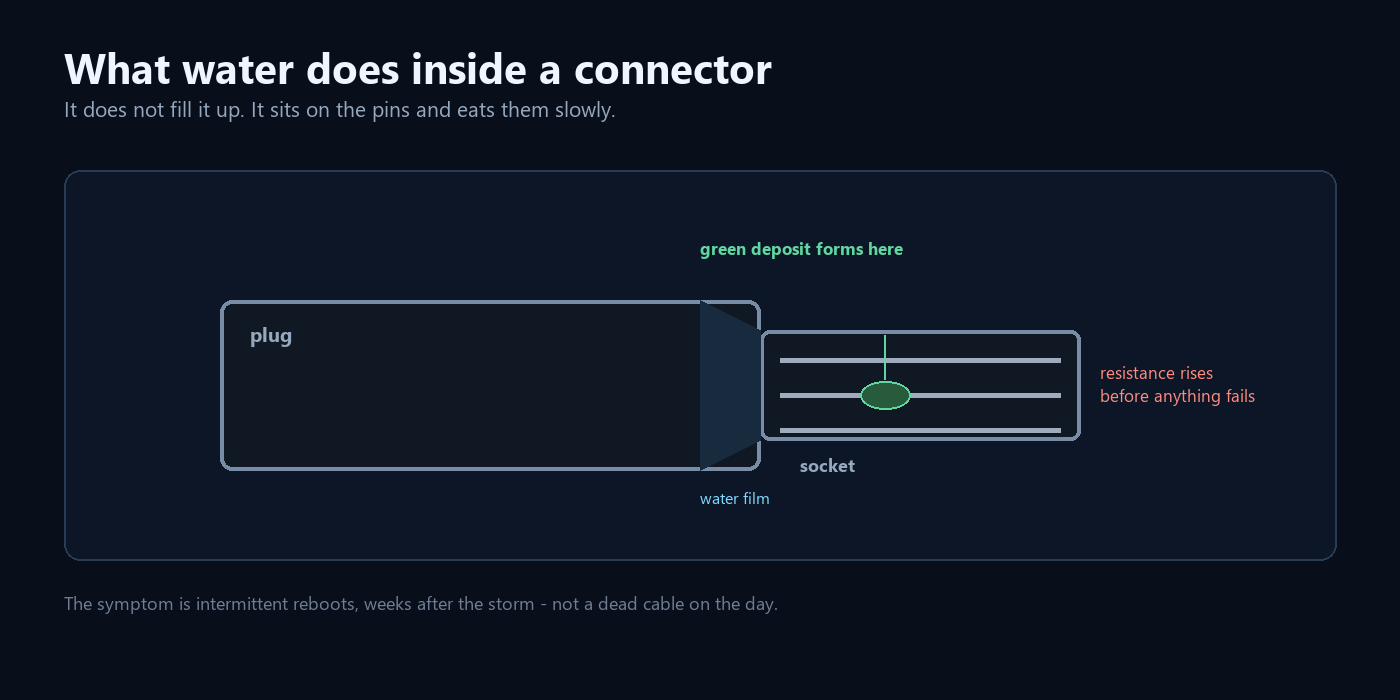
If your connection started dropping a few weeks after a storm, and the sky is clear, the connector is the first thing to inspect. Water does not usually kill a Starlink cable on the day it gets in — it leaves a film on the pins, the film turns into a deposit, and the deposit slowly raises resistance until the dish starts restarting under load.
That delay is why people replace the dish when they should be drying a plug.
Three checks, five minutes
1. Unplug at the dish end and look inside. Hold it up to the light. What you are looking for is green tint, dark discolouration, or a white crust on the pins. Clean metal is the only acceptable answer.
2. Shake the plug over a tissue. Any moisture at all means the seal has failed, even if the connection still works today. Water inside a mated connector has nowhere to go except onto the pins.
3. Check the drip loop. Look at the cable above the entry point. If it hangs below the gland before going up, the lowest point is collecting water — which is exactly the path water follows into the connector.
If you find corrosion, work down this list
Isopropyl alcohol on a cotton bud, dried completely, then reassembled with the seal seated properly. Do this before the resistance climbs far enough to cause reboots. Once the deposit is thick enough to lift a pin off its contact, cleaning buys you weeks rather than months.
Dry the connector, then find where the water came from: a damaged seal, a cable running uphill into the gland, or a plug left unmated in rain. If you only dry it and change nothing, it will be wet again after the next storm.
The socket is part of the dish. Surface cleaning can help briefly, but a corroded socket on the terminal itself is not something a user should be scraping at. This is the point where support becomes the sensible next step rather than a last resort.
A split jacket lets water travel inside the cable itself, and no amount of drying the plug will fix that. Replace the run. This is the one case where spending money is faster than troubleshooting.
Why the drip loop matters more than the seal
A perfect seal fails eventually. A drip loop means that when it does, the water is already being diverted away from it.
The rule is simple: the cable should rise into the entry point, not descend into it. If the lowest point of the run is the gland, every drop that lands on the roof is being delivered to the weakest joint in the system.
What corrosion does electrically
A clean contact has a resistance measured in milliohms. A corroded one can be ten or a hundred times that, and the resistance is not stable — it changes with temperature, with vibration, and with how much current is flowing.
Because the same cable carries power, that instability shows up as voltage sag at the dish. The dish does not report “bad cable”; it reports a disconnect, or simply restarts. Meanwhile the data pair is suffering the same corrosion, which is why the connection also gets flaky in ways that look like a radio problem.
This is the reason a corroded connector is so often misdiagnosed. It presents as three unrelated faults — restarts, dropouts and slow speeds — because the same damaged joint sits in the path of all three.
Prevention that costs nothing
- Never leave a plug unmated in the weather. Cap it, or bag it. An open connector facing upward collects water directly.
- Keep the drip loop. The lowest point of the cable should be below the entry point, never at it.
- Unplug as rarely as possible. Every mating cycle wears the seal. If you move the dish often, buy a second cable rather than unplugging the one you have.
- Check once a season. Ninety seconds, no tools, and it catches the problem while it is still green tint rather than a dead pin.
How to tell it from the other two causes
| What you see | Connector problem? | What instead |
|---|---|---|
| Drops cluster after rain | Yes, almost certainly | — |
| Drops cluster in cold weather | Unlikely | Heater load on a marginal supply |
| Drops cluster at the same clock time | Unlikely | Power cycling or firmware |
| Drops whenever it is windy | Sometimes | A cable flexing at a tight bend |
The seal is a consumable
People treat the rubber seal inside a connector as a permanent feature. It is not. It compresses each time the plug is mated, it hardens with UV and heat, and after a few seasons it stops sealing even if it still looks intact.
That is the case for treating the cable as a wear item rather than an accessory. A cable that has been through several winters outdoors, unmated and remated a dozen times, is a cable near the end of its reliable life — even though nothing about it looks broken.
When to stop and contact support
Contact support when the socket on the dish itself is corroded, when the dish restarts in dry weather with a clean, dry connector, or when you have replaced the cable and the fault persists. Bring photographs of both ends of the connector and the dates the drops started — a pattern after weather is a strong case, and photographs make it stronger.
If you are buying a replacement anyway, buy the shortest run that fits your layout. Every extra metre is more cable to hang water from, more jacket to damage, and more voltage to lose before the dish sees it.
Do this today: unplug the cable at the dish end and look at the pins. It takes ninety seconds, it needs no tools, and it is the single most informative check on a connection that fails after rain.
This is part of the troubleshooting index. If your drops follow cold weather rather than rain, reboots in bursts covers the power path, and if they follow the clock, drops that only happen in the evening explains why.