Sizing solar for a satellite terminal is not “match the panel watts to the dish watts”. A 40 W dish does not need a 40 W panel — it needs roughly ten times that, because the dish runs twenty-four hours a day and the panel only produces for four or five of them.
Get the arithmetic right once and every other decision — panel, battery, whether solar is even worth it — falls out of it.
Step one: daily energy, not watts
Watts tell you the size of the load. Watt-hours tell you what you have to replace tomorrow. A Mini at an average of 25–40 W plus a router at about 8 W comes to roughly 900 Wh a day before losses.
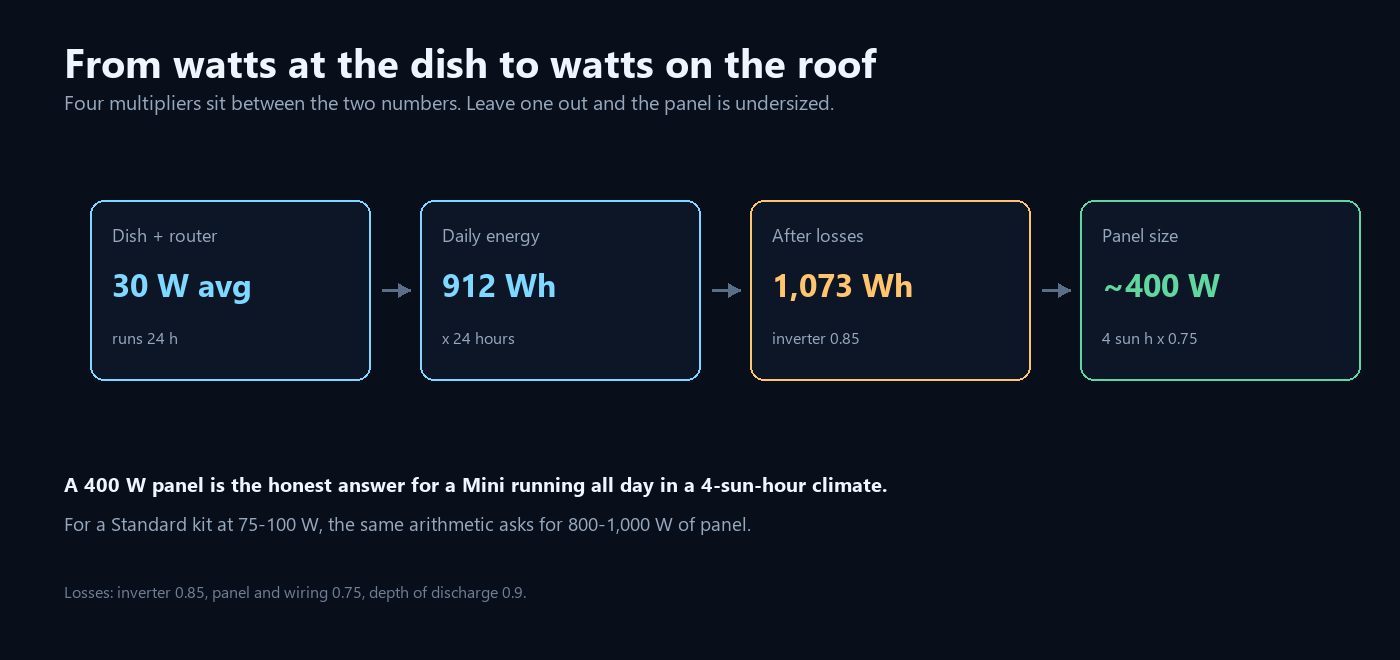
| Step | Number | Why |
|---|---|---|
| Load | 30 W average | Mini 25–40 W plus router |
| Daily energy | 912 Wh | × 24 hours |
| After inverter | 1,073 Wh | ÷ 0.85 conversion |
| Panel | ~400 W | ÷ (4 sun hours × 0.75) |
Why the panel looks absurdly large
Four hundred watts of panel to run a forty-watt device sounds wrong until you look at the duty cycle. The dish is on at 3am; the panel is producing nothing at 3am. Solar sizing is therefore about the ratio between generation hours and consumption hours, not about matching nameplate numbers.
For a Standard kit at 75–100 W the same arithmetic asks for 800–1,000 W of panel. That is a real array, on a real roof, and it is the point at which many people should honestly conclude that solar is not the answer for a fixed install with grid power available.
It might keep up for a few hours of use a day. For a dish running around the clock it replaces about a quarter of the daily energy, which means the battery slowly empties.
Sizing for December gives you a large array that is mostly wasted in June, and sizing for June leaves you short all winter. The usual compromise is to size for the shoulder season and accept generator or grid top-ups in midwinter.
A big panel with a small battery wastes the afternoon; a big battery with a small panel just takes longer to empty. The pair has to match the daily energy, not each other.
The season is the hidden variable
Peak sun hours are not daylight hours. Most of the US sees roughly 5–6 in June and 2–3 in December, which means a system sized for summer delivers around 40 percent of its rated output in midwinter.
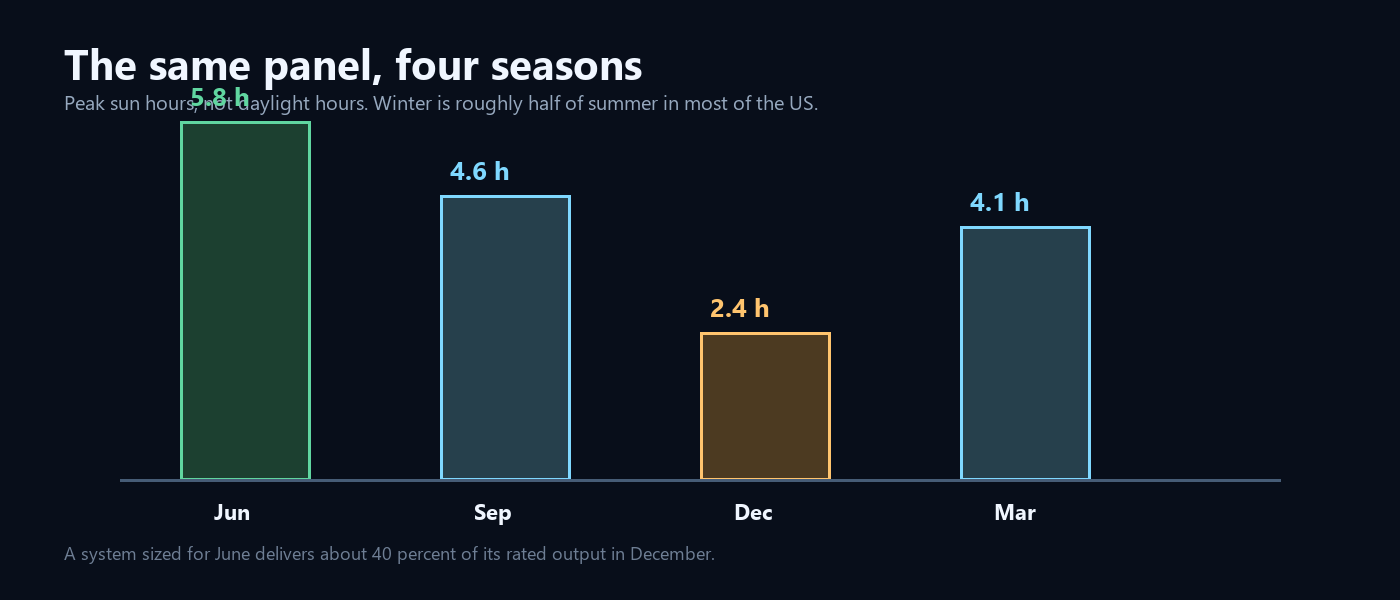
Latitude makes this worse or better, and snow makes it worse again: a panel with a centimeter of snow on it is a panel producing nothing, which is precisely when the dish is also drawing its most due to snow melt.
Three ways to shrink the array
If the number above comes out larger than you can install, the useful question is not “bigger panel” but “smaller daily energy”. Three levers, in order of effect.
Remove the inverter. Ten to twenty-five percent of everything, gone, by feeding the terminal from DC where the hardware allows it. On a 900 Wh day that is 150 Wh of panel you do not have to buy.
Schedule the load. A dish does not have to run all night at full power if nothing is using it. Some installations put the terminal on a timer or a switch for the hours nobody is awake, which turns a 24-hour load into an 18-hour one and cuts the array by a quarter.
Choose the efficient generation. The official averages differ by a factor of three across the current hardware: Mini at 25–40 W, the newer V5 at 35–50 W, and the older Standard 4 X at 75–100 W. The dish you already own may be the largest single variable in the array size.
Why the panel cannot feed the dish directly
A 200 W panel does not produce 200 W. It produces whatever the light gives it — nothing at night, a fraction in cloud, more than its rating in cold clear conditions — and the terminal needs a steady, regulated supply. The mismatch is the whole reason a battery sits in the middle.
So the chain is: panel charges the pack, pack feeds the terminal at a voltage the terminal expects. The pack also absorbs the afternoon peak that the dish does not need at 2pm, and returns it at 11pm when the dish does.

Panel angle is not a detail
A panel lying flat in a northern latitude loses a meaningful fraction of its output in winter, which is exactly when the budget is tightest. Tilting it toward the winter sun and adjusting twice a year is the cheapest capacity you will ever add.
Snow is the other angle problem: a tilted panel sheds it, a flat one collects it. If your site gets real winters, mounting tilt is worth more than an extra hundred watts.
Where the panel is worth it, and where it is not
- Worth it: a cabin used seasonally, a boat at anchor, a site where the alternative is a generator running daily.
- Marginal: a full-time off-grid home, where the array becomes a serious capital cost and winter still needs backup.
- Not worth it: a house with grid power that occasionally loses it. A battery and a charger beat an array you use eight days a year.
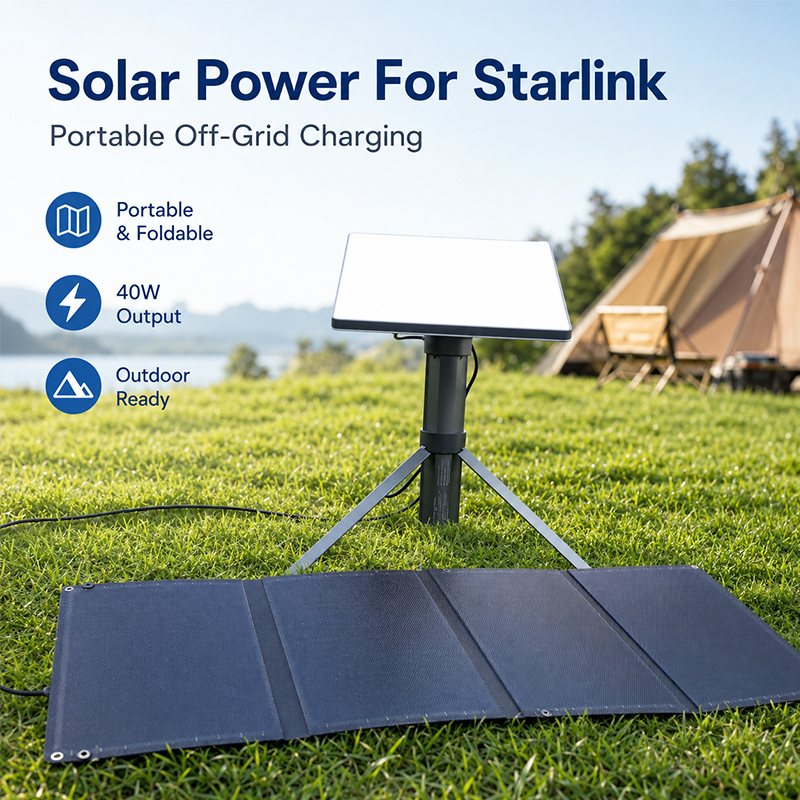
For the panel side of a portable kit, the practical product is a 200 W folding panel rated IP67, which folds to roughly 21 × 28 cm and goes in a backpack. The Fusynthx 200 W folding solar panel is exactly that unit. It is made by Fusynthx, which is our own brand, and compatible with Starlink rather than endorsed by them. We do not sell it on this site; it belongs here because portability is what decides whether an array gets deployed at all.
One rule comes with it, and it is worth stating plainly because getting it wrong is a warranty conversation: do not connect the panel directly to the terminal. The panel charges a battery pack, and the pack feeds the dish. Same reason your phone charger does not plug into a solar cell.

What a realistic kit looks like
For a Mini running continuously in a four-sun-hour climate, the rounded numbers are: 400 W of panel, 2 kWh of battery, and a charge controller sized above the panel’s short-circuit current. The battery covers one cloudy day; the panel replaces a sunny one.
Two kilowatt-hours is the number people under-estimate. The panel is visible and gets specified carefully; the battery hides in a cabinet and gets sized on optimism. It is the battery that decides whether a single grey day takes you offline.
Scale that kit up for a Standard dish and it stops being portable: 800–1,000 W of panel and 4–6 kWh of battery is a fixed installation with a mounting plan, not a suitcase. Knowing which of the two you are building is most of the decision.
Do the arithmetic before buying anything
- Write down the daily Wh. Load in watts × 24 hours. Use the manufacturer’s average figure, not a peak.
- Divide by 0.85 if there is an inverter, and by 0.9 for battery depth of discharge.
- Look up your winter peak sun hours — a real number for your latitude, not a summer average.
- Divide again by those hours and by 0.75. What is left is the panel you actually need.
One honest test before you buy: multiply your daily Wh by thirty and compare that to what the array plus battery would cost. If the number looks like a car payment, the correct answer may be a generator for the rare weeks rather than an array for all of them.
Do this today: take your dish’s average wattage, multiply by 24, and divide by your winter sun hours. If the answer is more panel than your roof or your budget allows, you have just saved yourself from buying a system that fails in January.
This is part of the Starlink 101 framework. The cold-weather version of this arithmetic is in the overland power guide, and the per-device breakdown is in what a dish actually draws.