On a boat, the power problem is not capacity. It is that the supply is not stable, the connector is not sealed, and everything metal is being slowly eaten. Get those three right and the dish behaves; get them wrong and you will spend a season rebooting a terminal that was never broken.
This is the last of four scenario guides, and it is the one where the electrical advice from camping stops working.
A boat’s 12 V is three voltages
A nominally 12 V system sits around 14.4 V while charging, 12.8 V at rest, and dips toward 11.6 V when a big load kicks in — a winch, a fridge compressor, an inverter. The dish sees all three, in that order, on an ordinary afternoon.
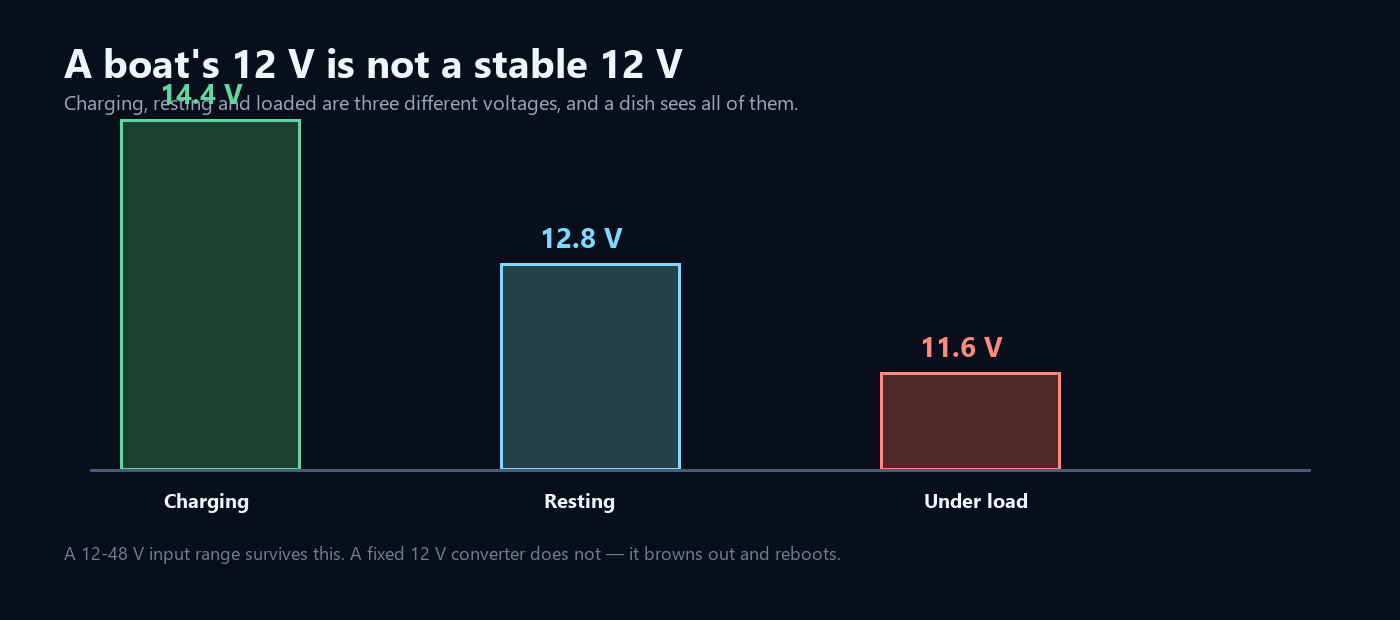
The Mini’s published input range of 12–48 V is what makes it viable here: a terminal that only accepted a tight 12 V would brown out every time a pump started. If you are feeding it from a converter instead, check that the converter tolerates the low end rather than assuming the nominal figure.
Salt is the failure that ends installs
Seawater does not need to submerge anything. Spray lands, dries, leaves salt, and the salt holds moisture against the metal. The result is corrosion inside connectors that still look fine from outside, and intermittent faults that vanish when you unplug and replug.
Three measures that actually help: keep every joint above the deck and out of the spray path, use the sealed cable assembly rather than an adapted RJ45, and inspect the connector at the end of every trip rather than at the end of the season. A quick rinse with fresh water after a passage is worth more than any coating.
The rating covers immersion and spray, not chloride attack on the connector pins. A unit can hold its IP67 rating and still corrode internally within a season of regular spray.
Capacity does not fix a wiring problem. A dip under load comes from resistance in the run, not from stored energy — thicker cable and shorter runs do more than extra amp-hours.
A boat has unobstructed sky, which helps, and a moving shadow problem, which does not. Partial shading on a panel cuts output far more than its area suggests.
Motion changes what “mounted” means
A boat does not simply move; it accelerates, rolls and slams. A mount that holds a dish still in a driveway can work itself loose over a season of that, and the failure is gradual rather than dramatic — a degree of drift, then an obstruction figure that climbs for no reason the owner can see.
Two practical rules. Fix to structure rather than to a surface: a rail is not a bulkhead, and a bimini frame is neither. And check the fasteners after the first passage, not after the first season — the first trip is when everything settles.
Where the dish should not go
High and central is the instinct and it is often wrong. A dish on the coachroof has the clearest sky and the most spray; a dish under the boom has shade in one sector and protection from the worst of the water.
The compromise most boats land on is a removable mount: up when anchored, down when underway. That also solves the permission problem, because a dish that is stowed is not being used in motion.
What a sea-going setup looks like
| Part | What matters | Common mistake |
|---|---|---|
| Power source | Tolerates 11.6–14.4 V | Sizing for 12 V nominal only |
| Cable | Sealed assembly, drip loop | Adapted RJ45 into a deck gland |
| Mount | Mechanical fixing, not suction | Suction cups on a wet deck |
| Connector care | Fresh-water rinse, inspection | Replacing the whole cable |
For the DC path, the same logic as a vehicle applies with more margin: a 30 V DC output aimed at the terminal skips the inverter, which is one less thing to fail in a damp locker. The Fusynthx PM99 power mount is built for that role — 99.9 Wh, DC out, USB-C in — and it is made by Fusynthx, which is our own brand, compatible with Starlink rather than endorsed by them. We do not sell it here; it belongs in this guide because on a boat the inverter is the part most likely to be mounted somewhere it should not be.
Solar and shade: the boat difference
A boat has the best solar geometry available — an unobstructed horizon and, at anchor, the ability to swing into the sun. It also has a mast, a boom and rigging, and partial shade on a panel costs far more than the shaded area suggests.
Practical consequence: size for shade rather than for the rated watts. Two panels in different places, one of which is shaded at any moment, outperform one large panel that is partly shadowed all afternoon.
The battery sits below the waterline
Most boats keep their battery bank low and central, which is good for stability and bad for cable runs. Distance plus thin cable equals voltage drop, and voltage drop plus a load spike equals the brownout that reboots the terminal.
If the terminal is on the coachroof and the bank is in the bilge, measure the round-trip length and use that number — not the straight-line distance — when deciding cable gauge. This is the same arithmetic as a vehicle install, with worse geometry.
What nobody tells you about marine installs
The dish is the easy part. The hard part is that a boat is a hostile environment for anything electrical, and every choice compounds: a connector that is not sealed needs a joint that is not low, which needs a route that is not through a locker that floods.
Which is why the order matters. Decide the route first, then the mounting point, then the power path. Doing it in the other order — buying the mount, then discovering the cable cannot reach — is the most common way a marine install gets abandoned halfway.
The checklist before you leave the dock
- Measure the dip, don’t assume it. Watch a voltmeter at the dish feed while a pump or winch runs. If it drops below the terminal’s minimum, fix the wiring before the trip.
- Get every joint above the spray line. Deck glands fail slowly and silently; a joint inside the cabin does not.
- Fix the mount mechanically. Suction is for glass at a campsite, not for a wet deck in a swell.
- Bring a spare connector, not a spare dish. The failure you will actually have is at the cable end.
Do this today: put a voltmeter on the feed point and switch on the heaviest load you have. If the reading falls below the terminal’s published minimum, you have found the fault that will otherwise appear as random reboots at the worst possible moment.
This is the fourth scenario guide in the Starlink 101 framework. The vehicle version of the same electrical problem is in the overland power guide, and the plan and hardware rules for use offshore are in roaming, mobility and the ocean.