A pole is the cheapest way to fix an obstruction, and the only one that does not depend on the trees cooperating. It is also the mount type people get wrong most often, because a pole is not one product — it is a mast with a base, and the base is what fails.
Before choosing one, the arithmetic matters more than the catalogue.
Height is subtracted from the obstruction
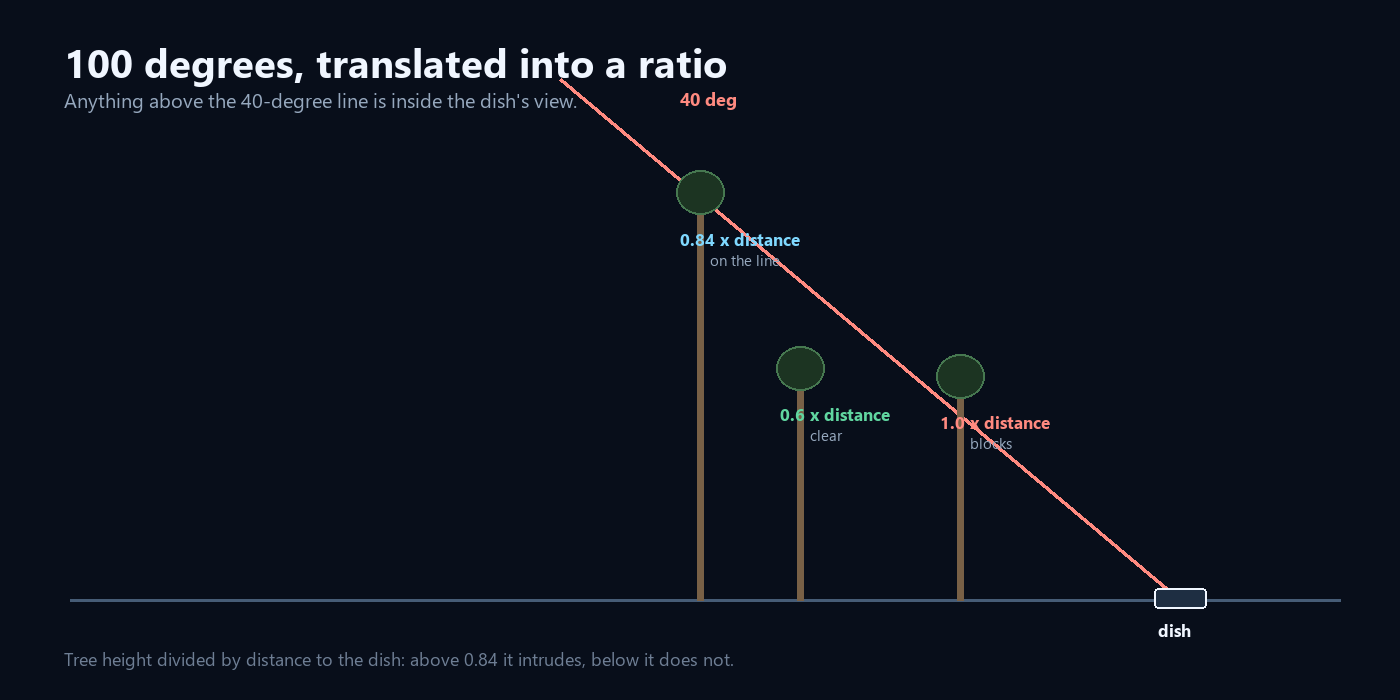
A dish needs a cone about 100 degrees wide, which puts the edge of usable sky roughly 40 degrees above the horizon. Anything rising above that line is in the way, and the test is a ratio: height above the dish divided by horizontal distance. Above about 0.84, it intrudes.
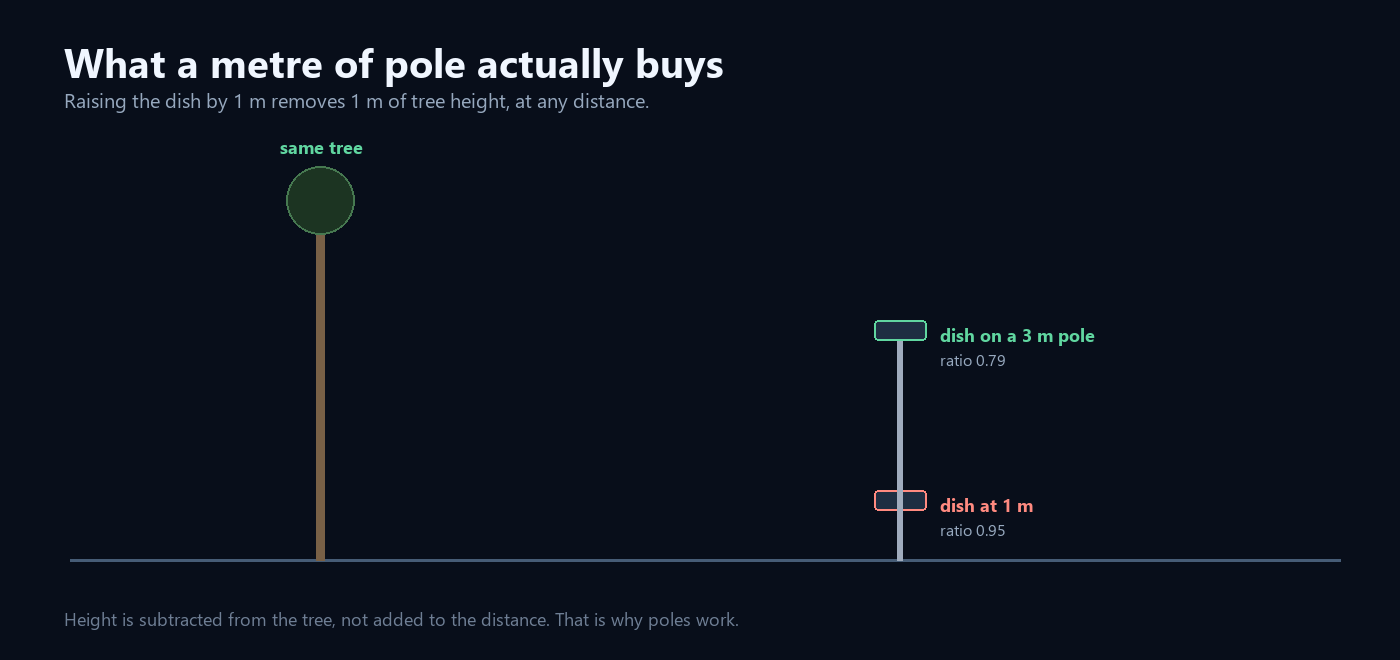
This is why raising the dish is so effective. A metre of pole takes a metre off the height above the dish, at every distance, for every obstruction simultaneously. Trimming a tree helps one branch in one direction; height helps all of them.
| Tree 12 m, dish at 3 m | Height above dish | Ratio at 10 m | Verdict |
|---|---|---|---|
| No pole | 9 m | 0.90 | Intrudes |
| 1.5 m pole | 7.5 m | 0.75 | Clear |
| 3 m pole | 6 m | 0.60 | Comfortable |
The three pole setups, and what each is for
Dig, sleeve, concrete, and you have a mount that does not touch the building at all. It is the most forgiving option for renters and for roofs you do not want to drill, and the hardest to move once it is set.
Cheap, tidy, and it gets you a couple of metres without touching the roof surface. The limit is the wall: a bracket on siding or a thin gable end will flex in wind, and flex is what cracks mounts.
For a vehicle or a temporary site, a telescopic mast that goes up in minutes and comes down for the drive is genuinely useful. It is also the option that needs the most care with guy lines and base loading.
What actually fails on a pole
Not the tube. The three things that fail are the base connection, the wind loading on the dish, and the cable entry.
The base. A pole is a lever, and the base takes the bending moment. A post driven into soil with no concrete will loosen within a season in most ground; a sleeve set in concrete with drainage will outlast the dish.
The wind load. At 70 mph a dish of about 0.4 m² pushes roughly 240 newtons — around 24 kg — sideways on the top of the pole. Multiply by the lever arm and you get the moment the base has to resist. This is why a taller pole needs a deeper base, not just a thicker tube.
The cable entry. A pole is a chimney. Water runs down the inside and arrives at whatever is at the bottom, which is usually a connector. Cap the top, drill a drain hole at the low point, and leave a drip loop before the entry into the building.
Getting the dish on and off
A pole mount is usually chosen because it is high, which means every future interaction involves a ladder. That is worth designing around: a quick-release interface between the dish and the mast means the dish comes down for cleaning, storage or a storm without disturbing the mast or the cable.
That is the case the Fusynthx Mini quick release bracket is built for — the dish lifts off the mount without tools, so the pole fixing is never used as a handle. It is made by Fusynthx, which is our own brand, and compatible with Starlink rather than endorsed by them. We do not sell it on this site; it comes up here because the removable half should be the dish, not the mast.
Guy lines, and when you need them
A pole that stands on its base alone is relying on the base to resist every bending load. Above a certain height and dish area, that stops being sensible and the mast wants guys — three lines at 120 degrees, anchored outside the base footprint.
Starlink’s own install documentation is blunt about this: mounts are not designed for high-wind, hurricane or tornado loads, and tethering should be used in all cases to prevent failure in an unexpected wind event.
Two practical notes. Guy lines are a trip hazard and a mowing hazard, so they need markers. And they change the load path: the anchors now take the wind, which means the anchors are the part to over-engineer rather than the pole.
What a pole does not fix
Height clears obstructions that are below the horizon line of the dish. It does not help with a canopy that arches overhead, and it does not help if the tree is so close that even a tall pole leaves it inside the cone.
It also does not fix a bad cable route. A tall pole usually means a longer cable run, and a longer run has more voltage drop. If the pole adds fifteen metres, check the length limit before you finalise the position — the cabinet is not the only constraint.
The order of operations
Measure first, then decide height, then decide the base, then decide the cable route, and only then buy hardware. Doing it in that order means every purchase is a consequence of a number rather than a hope.
It also means you can stop early. Plenty of sites need a 1.5 m eave bracket and nothing more, and discovering that from two measurements is faster than discovering it from two failed installs.
Measuring before you dig
- Measure the two numbers. Height of the obstruction above the intended dish height, and horizontal distance. Divide. If it is above 0.84 before the pole, decide how much pole you need to get under it.
- Check the ground, not the sky. What is under the base matters more than what is above the pole. Look for drainage, buried services and fill.
- Plan the cable route down. Where it enters the building determines whether you need a drip loop and a drain hole.
- Decide how you will service it. If the answer is “a ladder”, make the dish removable before you raise the mast.
Do this today: take the two measurements for the tallest thing near your intended spot — height above where the dish will sit, and distance. That single division tells you whether you need a pole at all, and how tall it has to be if you do.
This is part of the Starlink 101 framework. The geometry behind the ratio is in what 100 degrees of sky view really means, and the RV mounting guide covers the version that travels.