“Starlink needs about 100 degrees of clear sky” is the most repeated and least understood sentence in every installation guide. It does not mean a hundred degrees in every direction, and it does not mean the horizon has to be empty. It means the dish needs a cone — and once you translate that cone into geometry, you can check your site with a tape measure instead of an app.
What the number actually describes
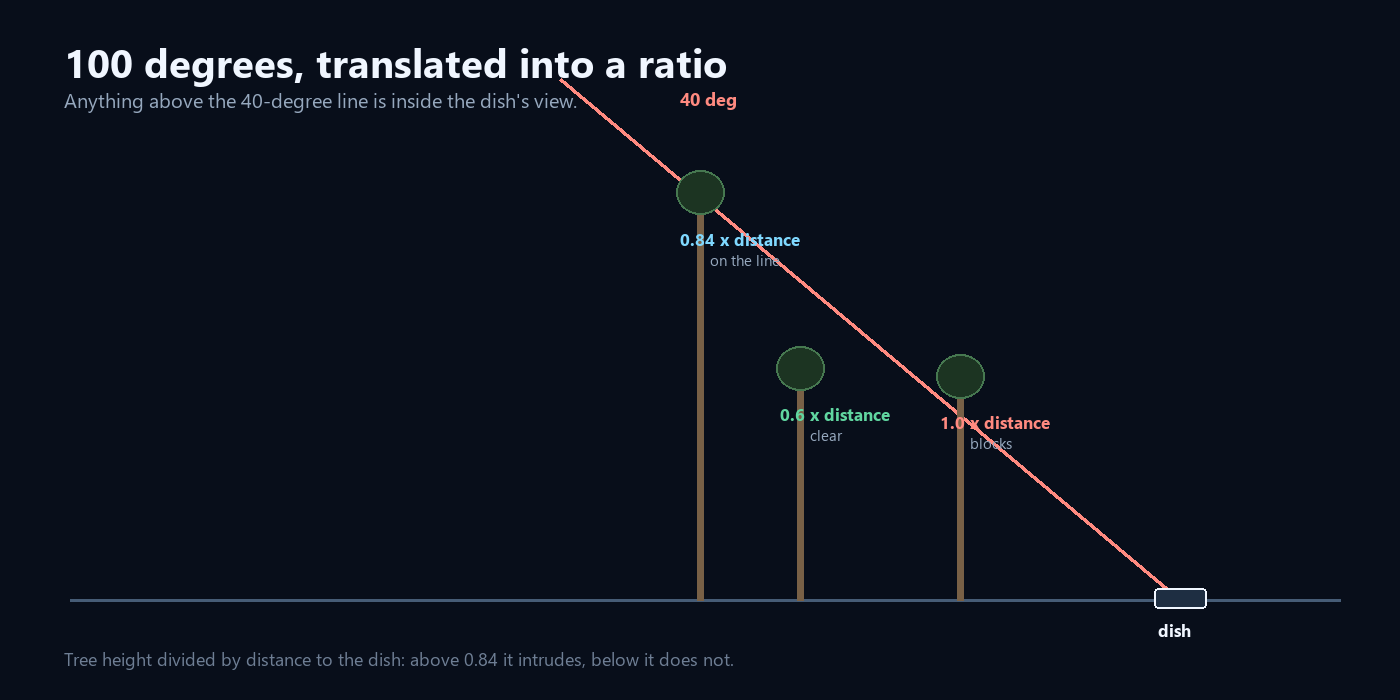
The dish’s field of view is roughly 100 degrees across, centred on where it points. Half of that is 50 degrees each side, which means the edge of the usable sky sits about 40 degrees above the horizon.
So an object only matters if it rises more than 40 degrees above the horizon as seen from the dish. A tree on the skyline at 10 degrees is irrelevant. A tree that fills a third of your upward view is not.
The rule you can use with a tape measure
Forty degrees is a tangent of about 0.84. That gives a rule that needs no trigonometry in the field: divide the height of the object above the dish’s mounting height by its horizontal distance. If the answer is above 0.84, it intrudes.
| Object | Distance from dish | Ratio | Verdict |
|---|---|---|---|
| 10 m tree | 8 m | 1.25 | Blocks |
| 10 m tree | 12 m | 0.83 | Borderline |
| 10 m tree | 20 m | 0.50 | Clear |
| 6 m hedge | 5 m | 1.20 | Blocks |
| 6 m hedge | 10 m | 0.60 | Clear |
Two details make this more generous than it first appears. The dish’s own mounting height counts against the tree, so raising it by a metre buys you a metre of clearance at every distance. And the geometry is directional: a tree due south is usually less of a problem than the same tree in the direction the dish actually looks.
Why the app and your eyes disagree
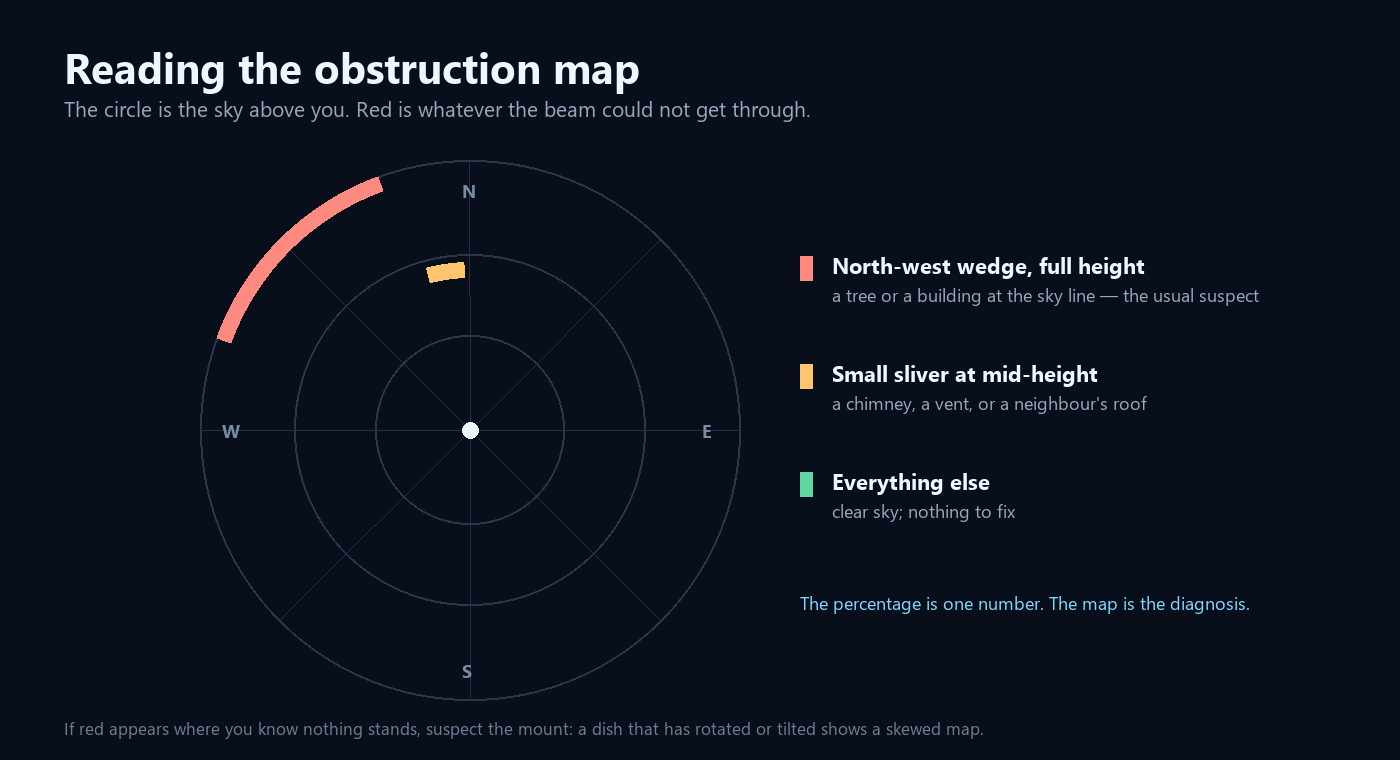
People routinely report a clean sky and a high obstruction figure. The reason is that the app is measuring the cone as the dish sweeps it, not the view from your standing position.
Three practical consequences. Standing under the dish is not the same as standing where you can see the dish’s targets. Looking straight up is not the same as looking at 40 degrees. And a single branch that crosses the cone for a few seconds a minute produces a surprisingly large number, because the metric is accumulated over time rather than sampled once.
Under about one percent, the dish routes around it and you will never notice. Between one and five percent you get brief dropouts. Above that, the ratio rule is telling you something real and no amount of re-aiming fixes it.
The dish does not look at one direction; it watches a 100-degree cone while satellites cross it. Choosing a gap is choosing where the cone starts, not what the cone contains. This is why trimming one branch rarely helps as much as expected.
One worked example
A house with a dish mounted 3 m up and a line of 12 m trees 10 m away. Height above the dish is 9 m, distance is 10 m, so the ratio is 0.9 — just over the line.
Two things would fix it. Moving the mounting point two metres further from the trees drops the ratio to 0.75. Or raising the dish by 1.5 m drops the height above it to 7.5 m, giving 0.75 as well. Both are cheaper than removing a mature tree, and both are reversible if the trees come down later.
This is why the advice is usually “get it higher” rather than “get a better dish”. The constraint is geometry, and geometry responds to height and distance — the two things a mounting decision controls.
Direction matters more in some places than others
In the northern hemisphere the dish generally looks toward the north, and in the southern hemisphere toward the south. That asymmetry means the cone is not equally exposed on all sides: an obstruction in the direction the dish favours will matter more than the same object behind it.
In practice this turns into a useful check. If your only problem object is on the far side of the house from where the dish faces, measure it before you worry about it. If it is in the facing direction, treat it as the deciding constraint on where the mount goes.
The seasonal version of the same number
Deciduous trees are a different height in July and February. A ratio of 0.8 in summer can become 0.95 in a wet spring, and snow on branches adds weight and reach for a few weeks a year.
The safe approach is to measure in the worst season, not the one you happen to be installing in. It costs nothing to look at the same tree in a different month, and it is the difference between an install that holds up and one that needs revisiting every spring.
What actually fixes a bad ratio
- Height. Every metre up buys a metre of clearance. A pole is cheaper than a tree surgeon and reversible.
- Distance. Moving the dish ten metres away from the tree changes the ratio more than any mount change.
- Direction. If the obstruction is in one sector, check whether another mounting point puts it behind the cone rather than inside it.
- Only then, trimming. It is the most expensive option and it grows back.
Do this today: stand where the dish will go and estimate two numbers for the nearest tall object — its height above your eye line, and its distance. Divide the first by the second. Under 0.84 means you can stop worrying; over it means you have a mounting decision to make before you order anything.
This closes the hardware chapter of the Starlink 101 framework. If the map is clean but the connection still drops, reading the obstruction map properly covers the other explanations, and how the dish steers its beam explains why the cone exists at all.