An RV mount is not a smaller version of a house mount. It has to survive a highway, a torsion-loaded shell, and a driver who forgets it is up there. The three approaches below fail in three completely different ways, and picking between them is really picking which failure you can live with.
Here is the arithmetic that decides most of it, before any product gets mentioned.
The wind load, worked out
Dynamic pressure is half the air density times the square of the speed. At 70 mph — about 31 m/s — that is 0.5 × 1.225 × 31², or roughly 590 pascals. A dish presents something like 0.4 m² of area, which gives a force near 240 newtons, or about 24 kg pressing on the mount at highway speed.
That number is why a magnet mount that feels rock solid in a driveway can leave the roof between two exits. It is also why the manufacturer’s rated wind speed matters more than the clamp’s closing force.
| Speed | Dynamic pressure | Force on 0.4 m² |
|---|---|---|
| 30 mph (13 m/s) | ~110 Pa | ~44 N |
| 50 mph (22 m/s) | ~300 Pa | ~120 N |
| 70 mph (31 m/s) | ~590 Pa | ~240 N |
Three approaches, three verdicts
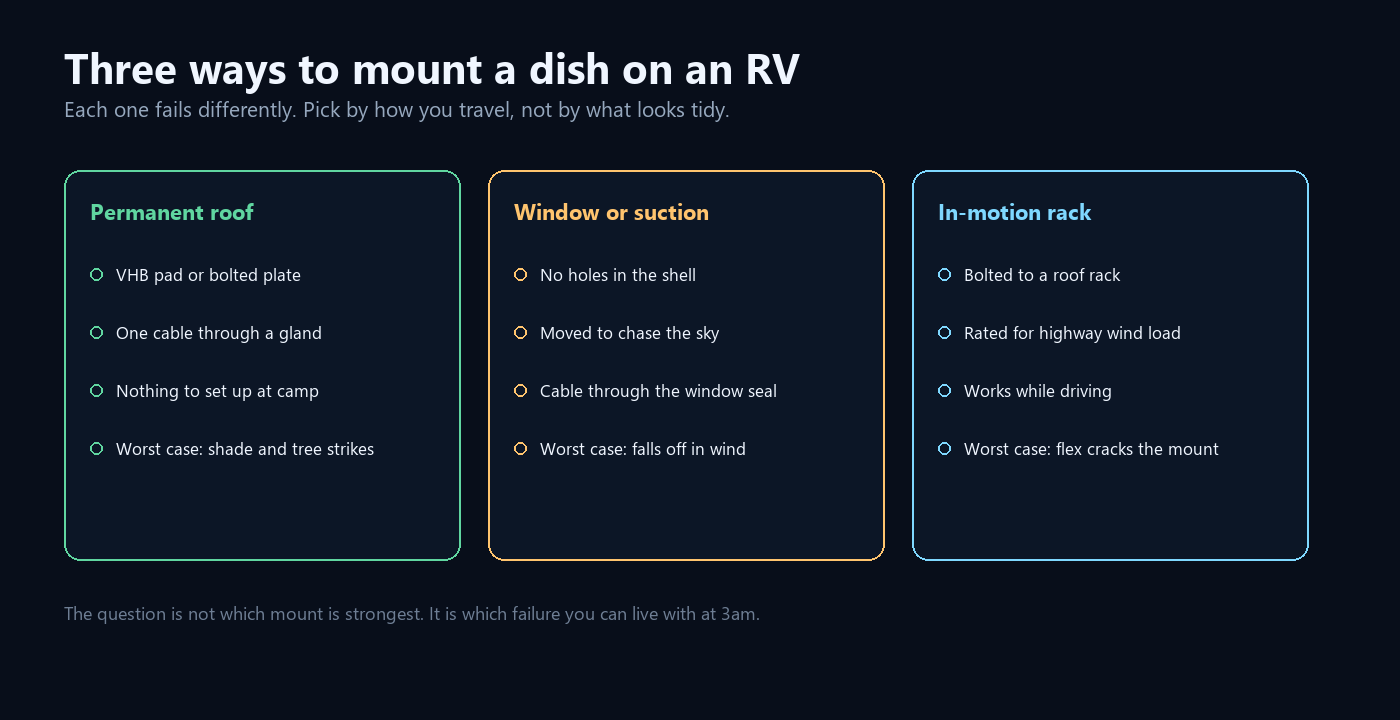
One hole, one gland, one cable, and nothing to set up when you arrive. This is the right answer if the RV is effectively a park model that moves twice a year. It is the wrong answer if you chase shade, because a fixed dish cannot be moved out from under a tree.
No holes, and you can walk the dish around a site to find sky. Above roughly 40 mph the load climbs faster than most suction hardware is rated for, and the cable has to enter through a window seal you will eventually forget to close properly.
This works, and it is the only option that keeps the link alive on the move. It demands a mount rated for the wind load above, a cable route that does not flex, and a plan for what the dish does when you enter a low-clearance area.
The hole in the roof, done properly
If you go permanent, the mount is the easy half. The other half is the entry point: a cable gland with a proper seal, positioned where water cannot pool against it, and routed so the cable is not the lowest point of the run.
The mistake people make is sealing the gland generously and then leaving the cable slack hanging below it. Water runs down the cable, sits in the loop, and works its way in through capillary action. A drip loop above the gland costs nothing and prevents most of it.
Temporary does not mean disposable
A suction or window mount still needs to be designed for the load, even if it only carries that load on site. Two things matter more than the cup itself: the surface it is stuck to, and whether the dish can tip rather than slide.
Clean, flat, non-porous surfaces hold. Curved fibreglass with a textured finish does not, no matter what the suction rating says. And a dish that is taller than it is wide will tip long before it slides, which is why the low-profile units survive gusts that take the tall ones off.
The cable route, while the wheels are turning
A cable that survives being installed will not necessarily survive being driven. The failure is not tension — it is flexing, at the same point, thousands of times.
Two rules prevent most of it. First, do not let the cable leave the mount at a sharp angle; a gentle bend radius over ten centimetres lasts far longer than a tight one. Second, fix the cable to the mount, not to the shell, so that the movement of the vehicle body does not pull on the connector at either end.
If the run passes through a moving joint — a slide-out, or the gap between cab and body — leave a service loop at that point. The loop absorbs the movement, and you can replace a worn section without replacing the whole cable.
Winter, storage and the parts that age
An RV mount spends most of its life not being used as a mount. It spends it being rained on, frozen, and left in a storage yard for six months.
The parts that age fastest are the seals and the adhesive pads. VHB tape is genuinely excellent for ten years when applied to a clean, flat, painted surface — and it fails within two seasons on a dusty or curved one. If your install depends on adhesive, the preparation is the whole job: clean with isopropyl alcohol, press and hold for the full recommended time, and keep the surface above ten degrees for the first day.
At the end of a season, take the dish off, dry the connector, and cap it. A plugged cable left to weather is how most of these systems fail over winter — not the mount, and not the dish.
What to buy, in order
- The mount, matched to how you travel. Permanent, portable or in-motion are three different products, not three price points.
- The cable route. Length, entry point and drip loop. Cheaper than the mount and more likely to cause the fault you remember.
- A way to take the dish off quickly. Whether for storage, theft prevention or moving it out of shade, a quick-release interface saves the mount from being used as a handle.
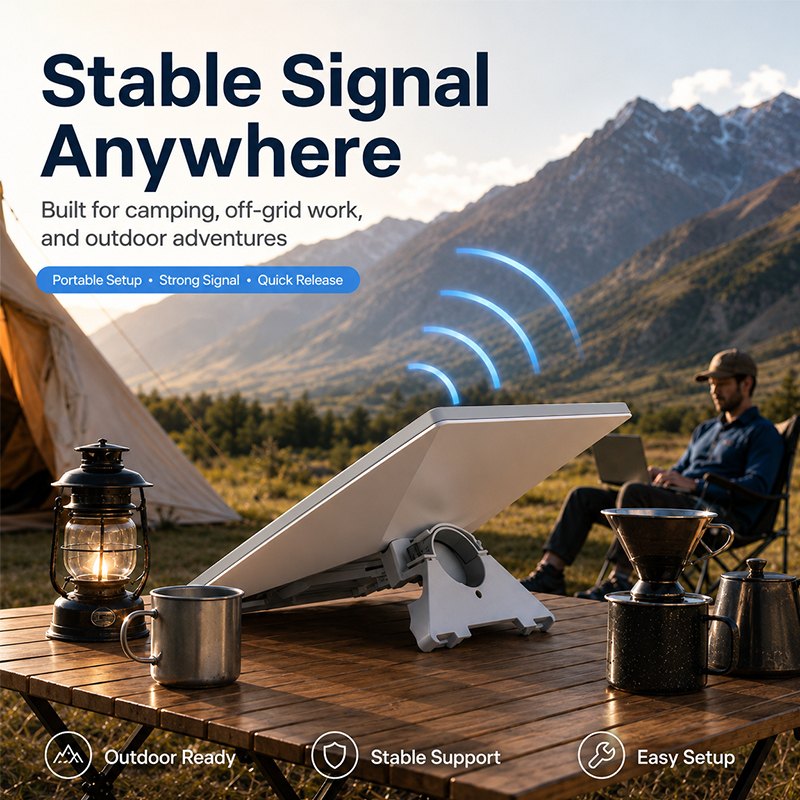
On that third point: a quick-release interface is exactly what the Fusynthx Mini quick release bracket is for. It lets the dish come off the mount without tools, so the roof fixing is never used as a handle or a lever. It is made by Fusynthx, which is our own brand, and it is compatible with Starlink rather than endorsed by them. We do not sell it on this site — the reason it comes up here is that separating “how the dish attaches” from “how the roof is sealed” is what makes a permanent mount tolerable.
The one thing people forget
Height. Every RV rooftop option puts the dish at roughly the same height, and height is the only obstruction fix that reliably works. If your usual sites are wooded, no mount on the roof will save you — a pole or a portable setup that reaches open sky will. Decide that before you drill.
Do this today: stand at the spot where the dish will go and run the app’s obstruction check at two different times of day. Rooftop installs are hardest to change later, and the ten minutes you spend up there now is the cheapest inspection you will ever do.
This is part of the Starlink 101 framework, in the power and install chapter. If you are also sorting out how the dish gets power while parked, power station sizing for the Mini covers the runtime arithmetic.