Day three, 2,000 metres, and the thermometer reads −6 °C before the sun clears the ridge. The pack that ran the dish for eighteen hours in September is now giving you six, and the dish itself is drawing more than it did then. Nothing is broken. Two separate effects have simply multiplied.
This is what an overland power plan has to survive, and it is not the same problem as a weekend camp in July.
Two effects that multiply, not add
Capacity drops. A lithium pack holds less usable energy as it gets colder — around 88 percent at freezing, closer to 80 percent at −10 °C, before you account for any manufacturer margins.
Load rises. The dish runs a snow-melt heater when it detects precipitation and low temperature. That takes a load that sits near 20 W in fair weather and can push it past 45 W while the heater cycles.
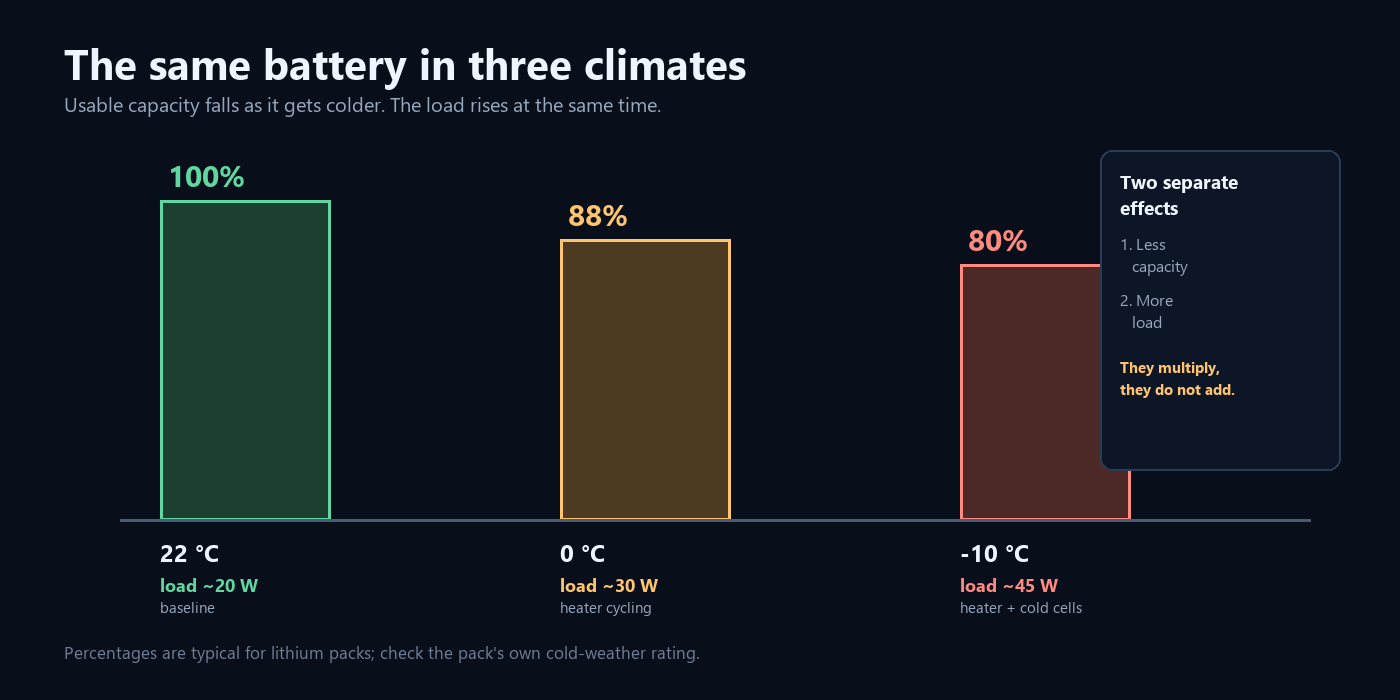
| Condition | Usable capacity | Dish load | Hours from a 500 Wh pack |
|---|---|---|---|
| 22 °C, dry | ~100% | ~20 W | ~19 |
| 0 °C, snow melt cycling | ~88% | ~30 W | ~12 |
| −10 °C, snow melt active | ~80% | ~45 W | ~7 |
Cold: the two rules that matter
Do not charge below zero. Almost every lithium pack refuses to accept charge below 0 °C, and the ones that try will damage the cells. If your plan involves a solar panel and a cold night, the panel will do nothing until the pack warms up — which changes the morning, not just the night.
Keep the pack above freezing when you can. An insulated box in the vehicle cabin, or simply bringing the pack inside the tent, is worth more runtime than a bigger pack left outside. Warm cells deliver more and accept charge again sooner.
Heat: the overland problem nobody plans for
Heat does not usually hurt the dish. It hurts the power hardware, and it does it in two ways that matter on a summer trip.
The inverter derates. Most portable inverters reduce output somewhere around 40 °C ambient, and a vehicle interior in summer passes that easily. A unit rated for the load at 25 °C may simply refuse it at 45 °C.
The cells age faster. A pack stored at high state of charge in a hot vehicle loses capacity permanently, month by month. If the kit lives in the truck between trips, leaving it at 100 percent in July is the most expensive habit in this article.
The DC advantage, in one line
Every conversion costs roughly a tenth to a quarter of the energy. Going from a pack’s DC output straight into the dish skips two of them, which on a cold trip is the difference between seven hours and roughly half a day.
That is the case the Fusynthx PM99 power mount is built for: 99.9 Wh, a 30 V DC output aimed at the terminal, and a USB-C input that can be fed from a vehicle or a panel. It is made by Fusynthx, which is our own brand, and compatible with Starlink rather than endorsed by them. We do not sell it here; it appears because the DC path is the one part of an overland kit that pays for itself in cold weather.
What heat does to a vehicle install specifically
A vehicle parked in summer sun reaches interior temperatures well above outside air. That matters in three places, and only one of them is the battery.
The power supply. A converter rated at 25 °C loses headroom as its case temperature climbs. Mounted in a closed compartment with no airflow, it will throttle or cut out on exactly the afternoon you wanted to work.
The cable. A run touching a hot metal surface is fine electrically and bad mechanically: the jacket softens, the bend radius tightens, and the seal at the connector takes the strain. Route away from the skin of the vehicle, not along it.
The display on the terminal. A dish in direct sun is the hottest thing on the roof. Airflow under it is worth more than any accessory, and a mount that lifts the panel a centimetre off the surface does more than a shinier bracket.
Snow on the dish, and whether to clear it
The terminal melts snow off its own face, which is why the cold row in the table above has a higher load rather than a lower one. That heater is doing the clearing, and it is drawing the power you budgeted for.
If you are watching the pack drain and the snow is wet and heavy, switching to a lower profile by clearing the face by hand saves more energy than it costs you in effort — and it stops the heater from cycling continuously through the night.
Solar at altitude, honestly
Altitude helps panels and hurts people. Thin air means less atmospheric loss, so a clear high-altitude day produces closer to the panel’s rating than a hazy day at sea level — but the cold that comes with altitude is what stops the pack accepting that charge.
The practical result is a narrow window: midday sun warms the panel and the pack at the same time, and that two-to-three-hour window is when the system actually recovers. Plan charging around it rather than “solar all day”.
A three-day plan that survives both
- Size to the worst night, not the average. Take the January row of the table above and multiply by 1.3 for margin. If that number feels absurd, your trip is a summer trip and you should say so.
- Two packs beat one big pack. One runs the dish while the other warms up or charges. It also halves the consequences of a single failure.
- Charge while driving, not at camp. The vehicle’s alternator is a far better generator than a folding panel, and it does not care about cloud.
- Cap the AC path if you use one. Do not plan on an inverter’s full rating in summer heat; derate it and size accordingly.
One last habit that pays for itself: write the runtime you actually got on the side of the pack, with the date and temperature. Three trips later you will have a better sizing table than anything published, because it will be measured against your dish, your habits and your weather.
Do this today: find the coldest temperature your trip is likely to see, and look up your pack’s charge cutoff. If it is 0 °C, plan where the pack sleeps — that single decision is worth more runtime than any accessory you can buy.
This is the first of four scenario guides in the Starlink 101 framework. The general arithmetic is in sizing a battery, and the evening-only version of the same problem is in running through an outage.