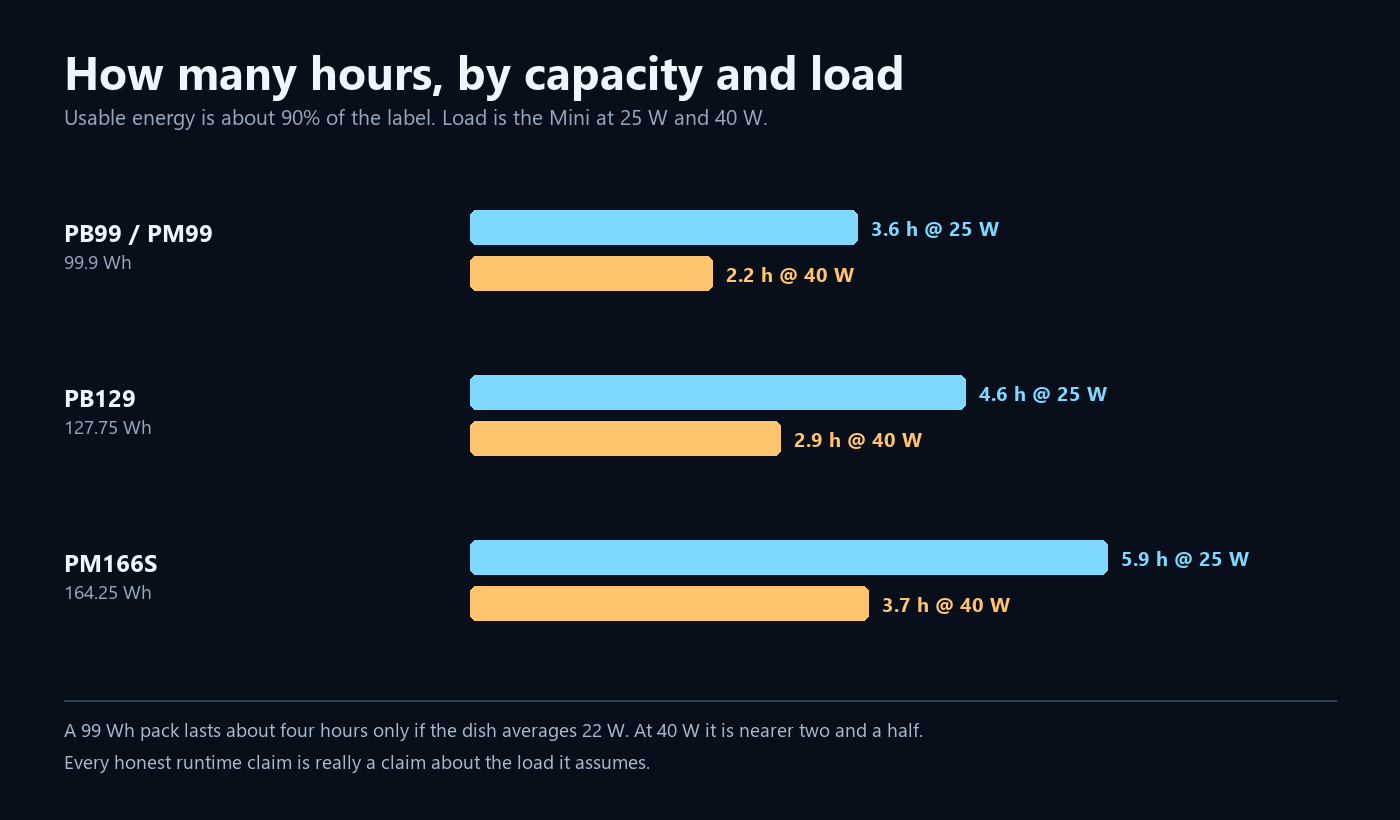
A 99 watt-hour battery does not give you four hours of Starlink Mini. It gives you about three and a half at a light load, and closer to two and a half if the dish is working. The gap between those numbers and the marketing figure is not dishonesty — it is the difference between a capacity and a rate, and it is the only thing worth understanding before you buy a battery.
Every runtime claim is really a claim about the load it assumes. Once you know the load, the arithmetic takes ten seconds.
What the label promises, and what you get
Watt-hours are energy: how much work the pack can do in total. Watts are power: how fast it does that work. A 99.9 Wh pack feeding a 25 W load lasts four hours in theory, three and a half in practice, because a battery is not a bucket you can pour out completely.
Two losses matter. The pack delivers less than its rating as it drains and as it cools, and every conversion step takes a slice. DC-to-DC is efficient enough to ignore at this scale — five percent at most. An inverter in the path is a different story, and it is why a DC output on the battery is worth paying for.
Assume 90 percent usable. That turns 99.9 Wh into about 90 Wh of real work, and it is the number you should do arithmetic with.
Temperature is the second loss, and the one people do not plan for. A lithium pack rated at 99.9 Wh delivers meaningfully less in freezing conditions — roughly 10 to 20 percent less at zero degrees, worse below that. Cold also thickens the electrolyte, so voltage sags sooner and the pack reports empty while it still holds charge. If your use is a winter evening, plan on the low end of every number on this page.
What the Mini actually draws
Starlink’s published range for the Mini is roughly 25 to 40 W, and it moves for the same reasons the bigger dish moves: acquiring a satellite, sustaining an uplink, and keeping itself warm when the temperature drops.
That range is wide enough to double your runtime, which is why “how many hours” is the wrong question and “at what load” is the right one. A pack that runs all evening with the dish idle on a warm night can die before midnight in February, with the same battery and the same dish.
This is also where the honest version of a product claim lives. “Four to five hours” is reachable — at around 20 to 22 W average, which is a light-load evening. At 40 W the same pack is a two-and-a-half-hour pack. Both statements are true; only one is useful without the load attached.
Three ways people use one, and what each needs
At 20 to 25 W average, a 99 Wh pack covers four hours with margin. This is the case the small packs are designed for, and it is the majority of real use.
Eight hours at 30 W is 240 Wh before losses. No single pack in this class covers it; you need the larger capacity or a second battery you can swap at lunch. This is where people under-buy, because the day feels like “a long evening” until it is 3 p.m. and the dish drops.
Two days is roughly 700 Wh at 25 W with a long night. No portable pack covers that alone — you are really buying solar input or a vehicle charging path, and the battery becomes the buffer rather than the supply.
Why a DC output changes the maths
The Mini takes DC input directly, which is the single biggest efficiency win available to you. Feed it from a battery’s DC port and you skip the inverter entirely. Feed it through a 120 V inverter you lose 10 to 15 percent before the dish sees anything — on a 99 Wh pack that is roughly half an hour of runtime, which is exactly the margin people complain about.
There is a related trap: a chain of adapters. Each plug-and-socket pair adds contact resistance, and a 30 V output stepped down through two converters to reach the dish can lose more than the inverter would have. Fewest connections, shortest cable, one conversion.
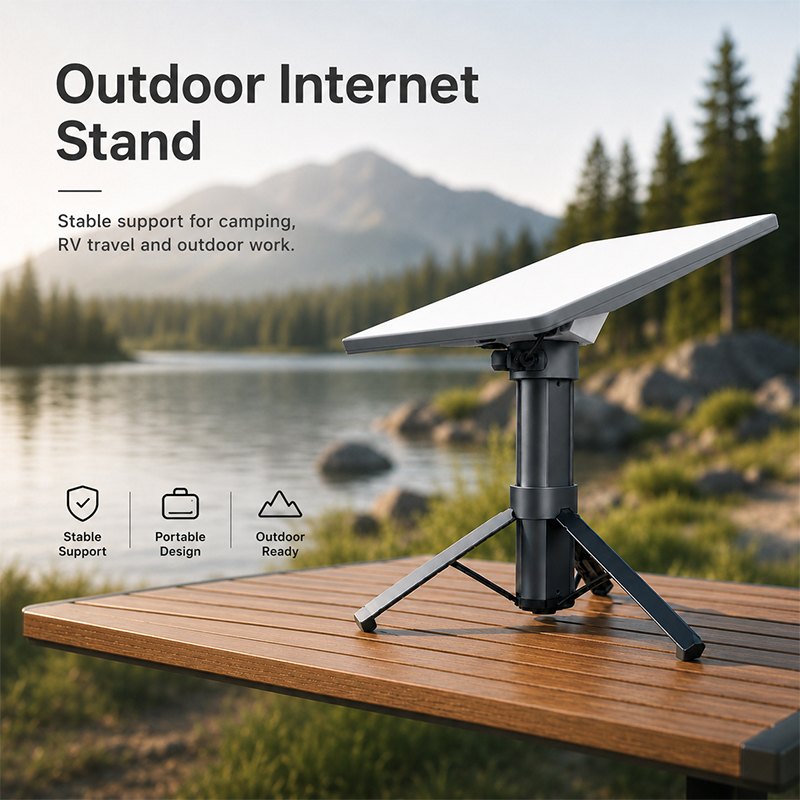
That is the case for a pack built around the dish rather than a generic power station: a dedicated DC output sized for the Mini’s 30 V input, no adapter chain, no inverter. The PM99 portable power stand is one of ours — made by Fusynthx, which is our own brand, and compatible with Starlink rather than licensed by them. It carries 99.9 Wh, outputs 30 V at 2 A, and doubles as the tripod the dish sits on. We do not sell it on this site; the reason to mention it is that the tripod and the battery occupying the same footprint is a real advantage when you are carrying everything.
Test your own in one evening
Manufacturer figures are a starting point, and your climate is not theirs. One evening of measurement beats every table on this page.
- Charge the pack to 100 percent and start the dish at the time you would normally use it.
- Note the hour it dies, and what you were doing — idle browsing, video, or an upload.
- Repeat once on a cold evening. The difference between the two runs is your winter margin.
Do this today: write down two numbers — your pack’s watt-hours, and the hours you actually need. Divide the first by the second. That quotient is the average wattage your usage assumes, and if it comes out above 30 W, a 99 Wh pack will not get you through.
If you have not chosen a pack yet, the wattage breakdown explains why the dish’s draw moves so much, and the Starlink 101 framework puts power in the order it should be solved: sky view, then power, then cable.