In a real outage the network is rarely the thing that fails first. The pattern is almost always the same: the link comes up in twenty minutes, then dies at hour six because nobody planned for the second night — and by then there is no one free to fix it.
Emergency power for a satellite terminal is not a bigger version of a camping battery. It has different priorities, different failure modes, and one requirement that overrides everything else: it has to work when nobody is there to babysit it.
What makes this different from camping
| Requirement | Camping | Response work |
|---|---|---|
| Runtime | One night | 36–72 hours unattended |
| Who operates it | You, present | Whoever is on shift |
| Failure cost | Inconvenience | Lost coordination |
| Weather | Chosen | Whatever is happening |
| Recharge | Solar if lucky | Generator, vehicle, or grid return |
That last row is why the design should assume a person who has never used the kit before. Labels, one switch, and a printed card beat a clever configuration that only its owner understands.
Sizing for 36 hours, not for a night
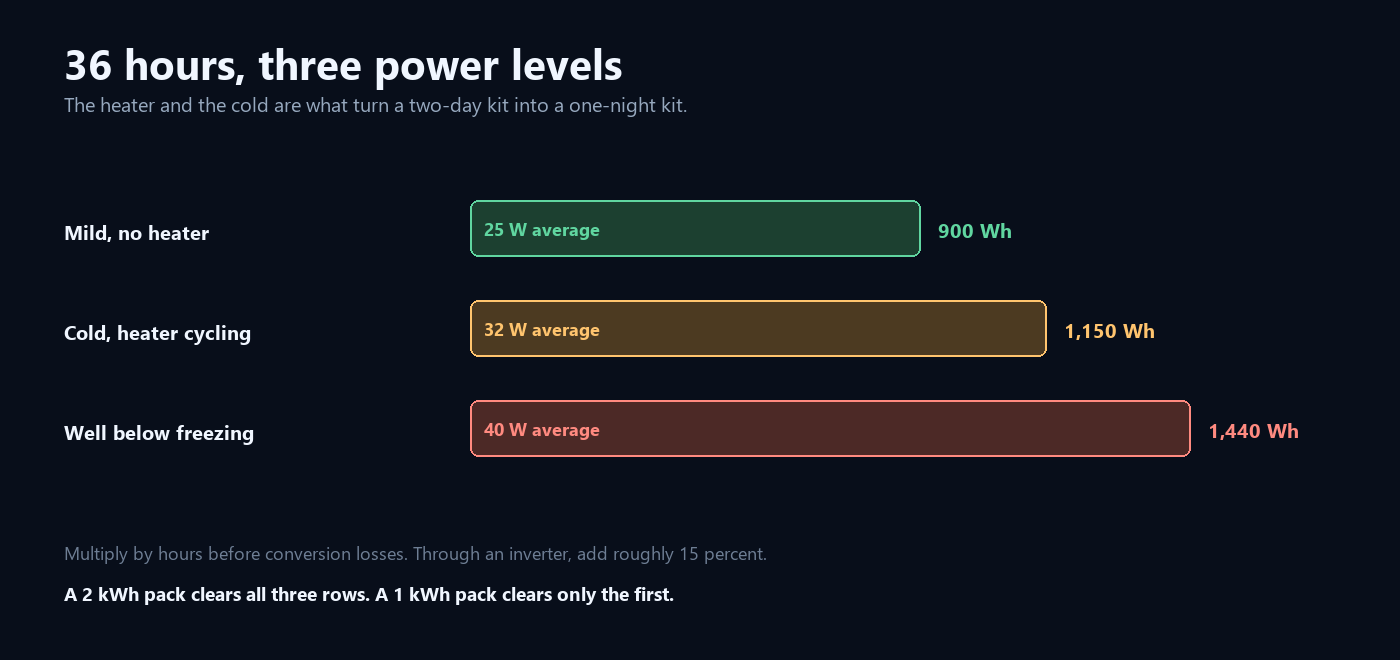
Take the worst case you are willing to plan for, and use the manufacturer’s published figures rather than optimistic ones. A Mini averages 25–40 W, so a 36-hour window is roughly 900–1,440 Wh before any conversion loss.
Two practical conclusions follow. A 1 kWh pack covers the low end and nothing more; 2 kWh gives you margin for the heater, the cold and the router. And the router matters more than people expect — a few watts, but the whole link depends on it.
A 2 kWh pack is 36 hours of Mini. It is not a week. Without a way to recharge — vehicle, generator, or returning grid — the kit is a countdown timer with a screen.
During a storm or at night, a panel contributes nothing, and the events that cause outages are the same events that block the sun. Treat solar as recovery, not supply.
An inverter that derates in heat or fails on a modified sine wave is worse than none, because it fails silently at hour four. Prefer DC where the terminal allows it, and size the inverter for continuous load rather than peak.
What a response team actually forgets
Not capacity. Three other things, in order of how often they cause a failure.
The recharge path. A pack with no way to refill is a timer. Teams routinely arrive with enough battery and no plan for day three, which is when the generator is out of fuel or the vehicle has been driven away.
The router’s power. The dish gets all the attention, and then the network dies because the small device bridging it was plugged into a strip that got unplugged.
The connector. In field conditions the cable end is what fails: mud, ice, being stood on. It is not repairable without a spare, and a spare costs less than the fuel burned fetching one.
Cold is the failure mode that catches teams out
Most response work happens in bad weather, which is exactly when lithium packs deliver less and refuse to charge below freezing. Two separate effects, multiplying: less usable capacity, and a recharge path that stops working until the pack warms up.
The fix is procedural rather than technical. Keep the pack inside the vehicle or a heated tent until it is needed, and treat “warm the battery” as a step in the deployment checklist rather than an afterthought.
Getting 2 kWh there is the hard part
Capacity is easy to specify and awkward to move. A 2 kWh station is roughly 20 kg, and it has to reach a site that may not have a road. That is a logistics problem, not an electrical one, and it changes the answer.
The usual resolution is to split it: two smaller packs that one person can carry, a vehicle that can reach the site, or a generator that runs only to recharge. Each option trades weight against fuel and noise, and the choice depends on who is doing the carrying.
Whichever you choose, the rule is the same: one person must be able to move and start the kit alone. A system that needs two people to deploy is a system that does not deploy at 3am.

A deployment kit that survives a tired operator
- One switch, labelled. Everything on one power strip or one breaker, marked in plain language.
- A printed card. Three lines: what to check, who to call, what not to unplug. Laminated, taped to the case.
- Spare cable and spare connector. The single most common physical failure is a damaged cable, and it is not repairable in the field.
- A light that works without the kit. Sounds trivial until the first night.
For the terminal side of the kit, the constraint is conversion loss. The Fusynthx PM99 power mount takes a 30 V DC output straight to the dish and charges over USB-C, which removes an inverter from the path that runs all night. It is made by Fusynthx, which is our own brand, and compatible with Starlink rather than endorsed by them. We do not sell it on this site; it belongs in this guide because in a response kit the losses you avoid are runtime you do not have to carry.
The drill that finds the problems early
Once a quarter, cut the power and see what happens. Not as a test of the battery, but as a test of the people and the procedure.
Run it with whoever would actually be on shift. Watch where they hesitate, note what they had to ask, and fix the card rather than the equipment. Almost every failure in the first ten minutes of a real outage is a documentation failure that a drill would have surfaced for free.
What to do before the next event
Do this today: write the runtime your kit actually delivers on one line and tape it to the case — hours, at what temperature, with which devices. Not the capacity in Wh; the hours. That number is what a person under pressure needs, and it is the number nobody writes down.
This is the third of four scenario guides in the Starlink 101 framework. The cold-weather arithmetic is in the overland power guide, and the household version of the same problem is in running through an outage.