Two things changed in the Canadian rural internet market within a few weeks of each other, and together they make this the most interesting moment to be buying in years. Starlink’s pricing has stayed flat while the incumbents’ promo-then-revert model keeps climbing — and the country’s largest rural provider entered creditor protection in November 2026.
Here is what the numbers actually look like, and what they do not tell you.
What Starlink costs in Canada
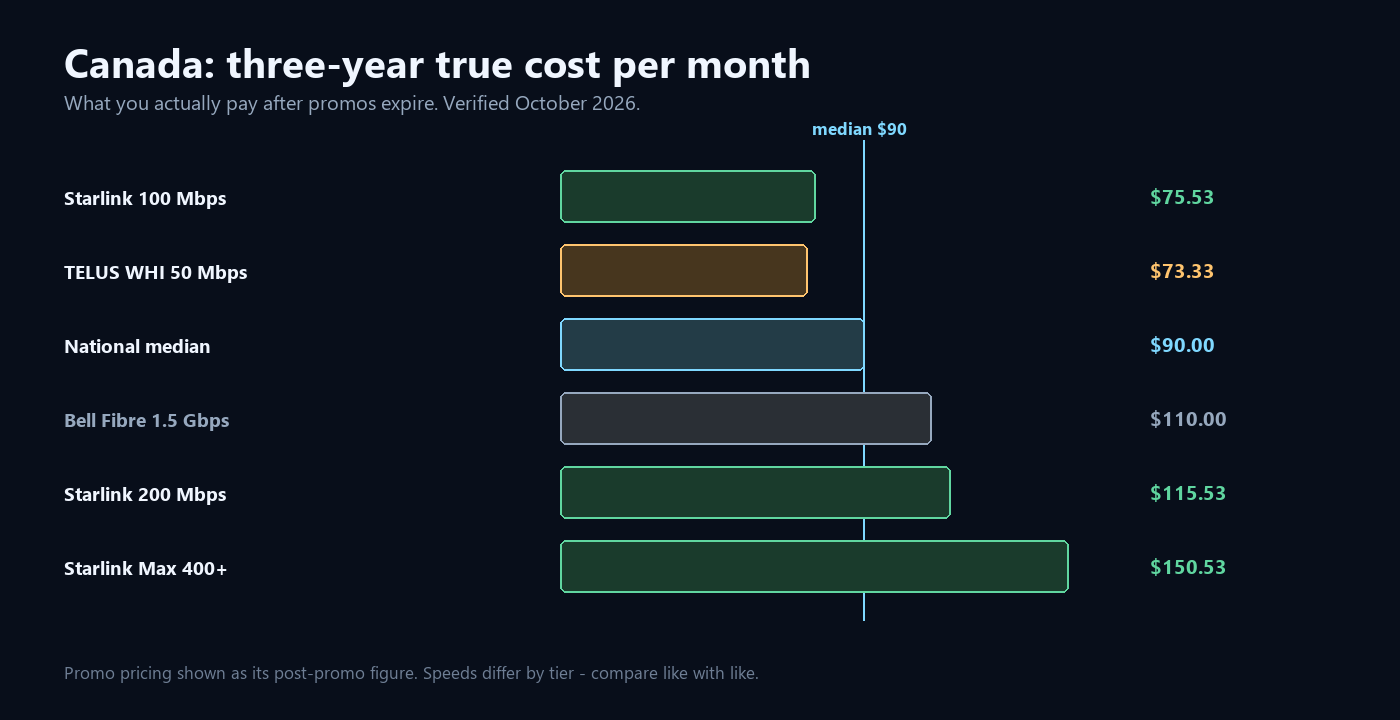
Three residential tiers, priced nationally rather than by province. As of October 2026 the advertised rates were CA$75 for the 100 Mbps tier, CA$115 for 200 Mbps, and CA$150 for the Max tier above 400 Mbps — all before tax, with no promotional period to expire.
| Tier | Monthly | Three-year true cost/month |
|---|---|---|
| Residential 100 Mbps | CA$75 | $75.53 |
| Residential 200 Mbps | CA$115 | $115.53 |
| Residential Max 400+ | CA$150 | $150.53 |
That “true cost” column is the important one. It is the average you pay over three years, which is the only comparison that survives a promotional rate.
Why flat pricing is the actual story
Canadian telecom pricing is built on a two-year promotional rate that reverts afterwards. A plan advertised at $65 is not a $65 plan; over three years it averages somewhere near $73 to $90 depending on the add-ons that were free during the promo.
Starlink’s pricing has none of that structure. The advertised number is the number, which is why its three-year true cost is within cents of its monthly rate. For anyone who has been through two promo cycles with a rural provider, that predictability is worth more than the headline discount.
The Xplore collapse, and what it means
Xplore — the rural provider formerly known as Xplornet, and for years the default answer for Canadians outside cable and fibre footprints — was granted creditor protection in November 2026 after failing to make loan payments.
What that means in practice is not that the network switches off tomorrow. Creditor protection is a restructuring process, and service usually continues through it. What it means is that the main non-satellite alternative for rural Canadians is now in a weaker position to invest in the fixed wireless upgrades that would have competed with Starlink.
If you are currently on a rural fixed wireless plan, the practical advice is to check the terms of your contract now rather than during an outage — particularly the hardware payment plan, which is often a separate obligation from the service itself.
Telesat Lightspeed is not here yet
Canada has its own low-orbit constellation in Telesat Lightspeed, and it is worth being precise about its status: it is building ground infrastructure and signing anchor customers, including a multi-billion-dollar Arctic military satcom contract announced in 2026, with landing stations under development in Quebec and Saskatchewan.
What that adds up to is a network whose first capacity is being sold to government and enterprise buyers before it reaches consumers. Anyone planning around “the Canadian Starlink” should plan around Starlink for the next few years.
Where fibre still wins, clearly
If a fibre connection reaches your address, the comparison is not close and price is not the reason. Fibre gives you symmetric upload, no weather dependence and a latency floor that a satellite link cannot match. Starlink’s entry tier may be cheaper per month than a gigabit fibre plan, but it is a 100 Mbps shared radio link against a dedicated gigabit line.
The honest framing is coverage, not performance. Starlink wins where nothing else reaches. It does not win on the driveway of a house that already has fibre.
The winter clause
Every Canadian Starlink review mentions snow. Almost none of them mention what snow does to the numbers in this article.
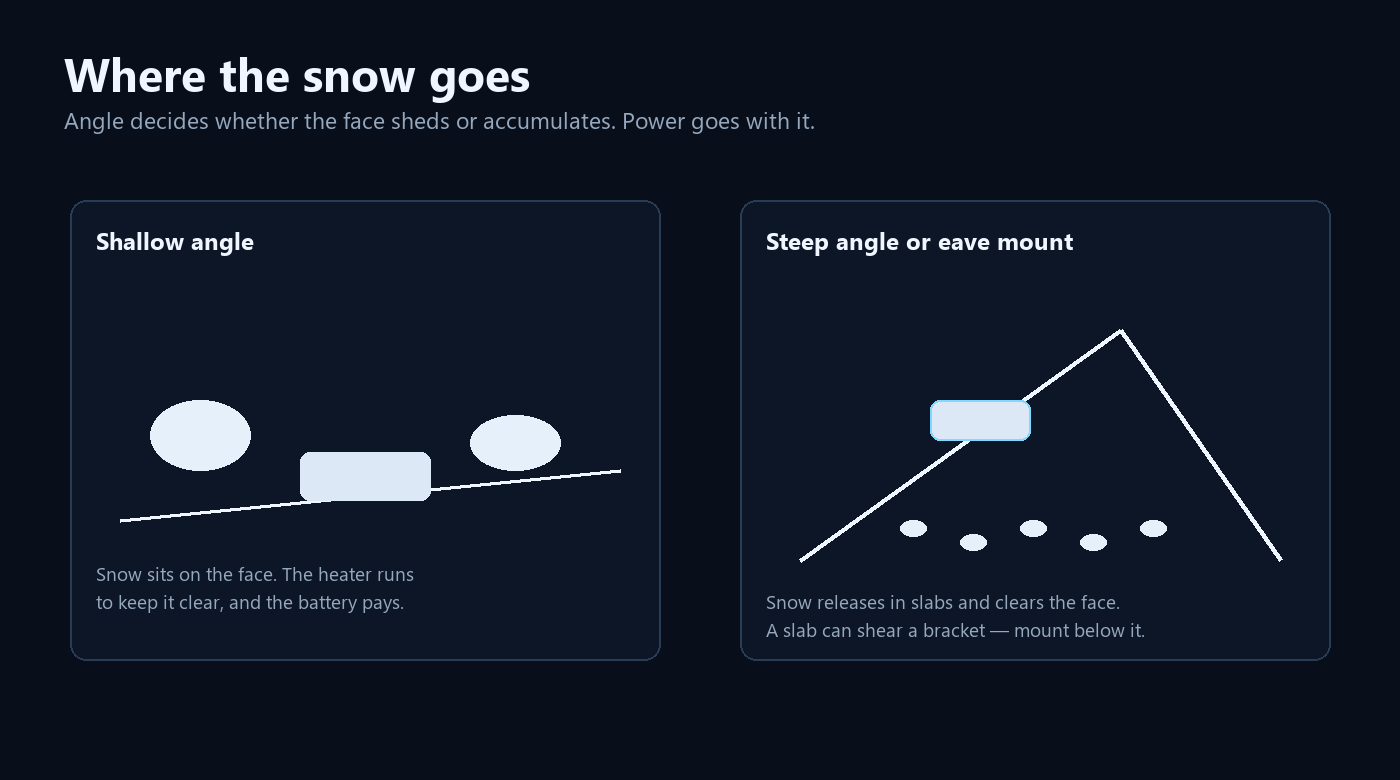
Melt mode raises the dish’s power draw substantially while it runs, which matters if your install is on a battery or an inverter, and matters not at all if it is on the grid. It also means a rooftop mounting decision made in summer should be re-checked with a February snow load in mind: a mount that sheds the white stuff cleanly is worth more than one that holds it.
What to check before you order in Canada
- Run the obstruction check at the actual install spot. Canadian winters matter here: a location that works in July can be marginal in February, and a dish that has to melt snow draws more power than the marketing assumes.
- Confirm the tier you need, not the top one. The 100 Mbps tier is cheaper over three years than the national median. Most rural households do not need 400 Mbps.
- Check your current contract’s exit terms. If you are leaving a rural provider, the hardware payment plan is the part that bites.
- Budget for the install, not just the plan. Mount, cable run and a power plan for outages are the three costs that never appear in the monthly figure.
Do this today: get the quote for your own address rather than the national figure. Canadian pricing is national, but availability and cell capacity are not — two houses in the same province can see different offers, and the only number that matters is the one attached to your civic address.
This sits alongside the other market guides in the Starlink 101 framework. If you are doing the same comparison south of the border, what Starlink actually costs in the US uses the same three-year method, and the fibre comparison covers when the answer is simply “not this”.