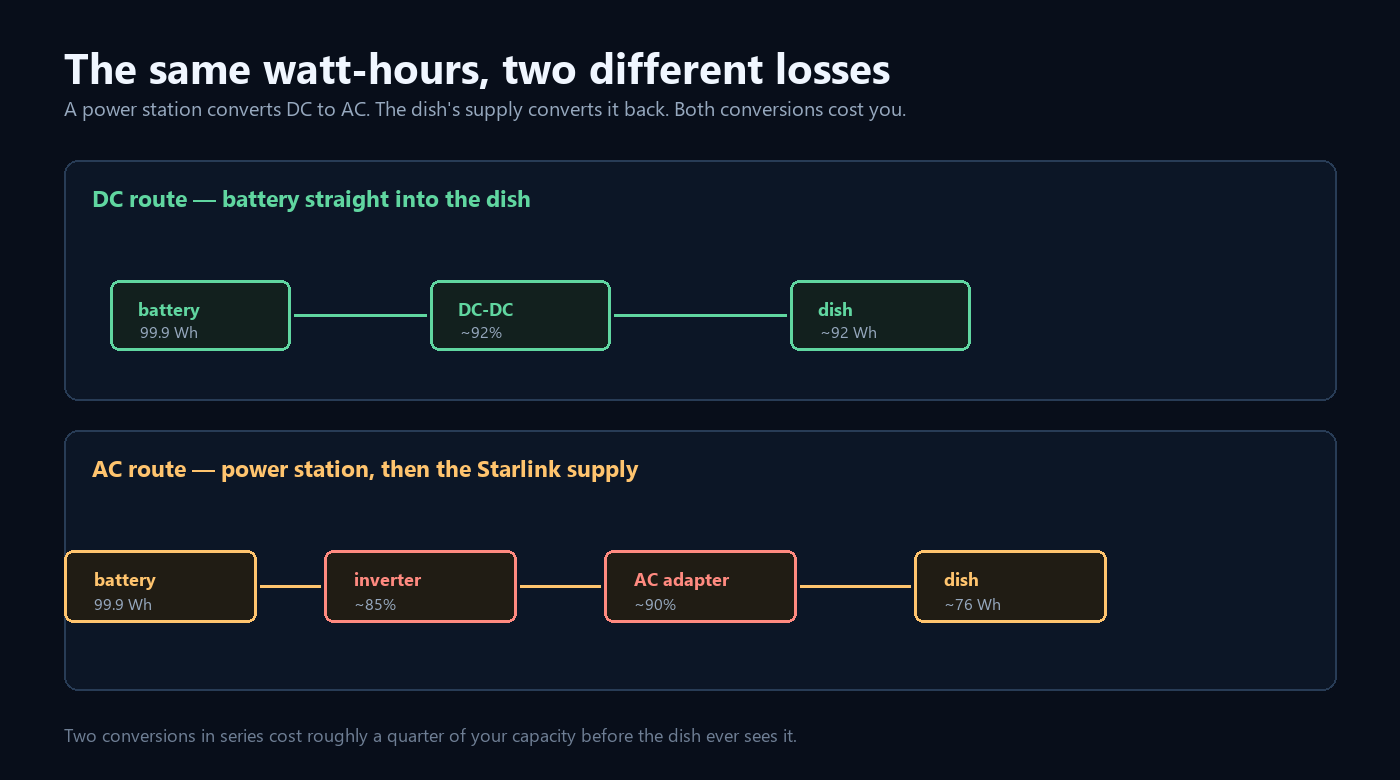
A Starlink Mini draws about 20 watts in normal use — far less than the standard dish, which is why the sizing question has a different answer for it. But the number that decides how long a power station runs one is not the station’s watt-hour rating. It is the fact that the Starlink Mini’s own supply is going to convert your AC back to DC on the far side of the inverter.
Two conversions in series cost roughly a quarter of the capacity you paid for. At 20 watts the runtimes are long enough that this matters less than it does for a standard dish, but it still decides whether a small station lasts an evening or half a week.
Why the inverter matters more than the battery
A power station is a battery, an inverter and a charge controller in one box. The inverter turns 12 or 24 volts DC into mains voltage. The Starlink Mini’s supply then turns mains voltage back into the low DC voltage it wants.
Most portable inverters run at about 85 to 90 percent efficiency, and a small supply is typically around 90. Multiply them and you keep roughly three quarters of what left the battery — at 20 W the loss is small in absolute terms, but it is the same 25 percent.
| Route | Stages | Usable from 99.9 Wh | Runtime at 20 W |
|---|---|---|---|
| DC to DC | One converter, ~92% | ~92 Wh | ~4 h 35 m |
| DC to AC to DC | Inverter ~85%, supply ~90% | ~76 Wh | ~3 h 50 m |
The sizing rule that actually works
Work backwards from the Starlink Mini’s draw, not from the station’s marketing.
- Average draw. About 20 W in use, roughly 15 W idle, and noticeably more during start-up or with snow melt on.
- Hours you need. Be honest — most people need six, not twenty-four. Sleep mode can cover the rest.
- Divide by 0.76 if you are going through AC, or 0.92 on DC. That is the capacity you must buy.
- Check the continuous AC rating. A 20 W load is tiny, but start-up surge and snow melt are not, and a station that trips on those will drop the link exactly when the weather is worst.
What the sizes actually buy you
At 20 W average and the AC route, here is the honest runtime:
| Station rating | Usable after conversion | Runtime at 20 W |
|---|---|---|
| 300 Wh | ~228 Wh | ~11 h 24 m |
| 500 Wh | ~380 Wh | ~19 h |
| 1,000 Wh | ~760 Wh | ~38 h |
| 2,000 Wh | ~1,520 Wh | ~76 h |
This is the part that surprises people coming from a standard dish: the same 500 Wh station that gives a standard kit most of an evening gives a Starlink Mini nearly a full day. The Starlink Mini’s efficiency is the single biggest reason it is the better choice for battery-powered use, and it is not close.
Starlink Mini against the standard kit, same station
The clearest way to see why the Starlink Mini is the battery-friendly dish is to run both through one 500 Wh power station on the AC route.
| Dish | Average draw | Runtime from 500 Wh |
|---|---|---|
| Starlink Mini | ~20 W | ~19 h |
| Standard kit | ~50–75 W | ~5 to 7.6 h |
That ratio is the reason a Starlink Mini plus a medium station is a realistic off-grid setup, while a standard kit plus the same station is an evening-and-a-bit.
The rating on the box is not the capacity you get
Two more deductions sit between the printed number and the hours you actually get, and both are normal rather than dishonest.
Depth of discharge. Lithium stations usually let you use most of the pack, but not all of it — expect around 85 to 90 percent before the battery management system stops you. A 1,000 Wh station is closer to 880 Wh in practice.
Cold. Lithium loses capacity as it cools, on the order of 10 to 20 percent around freezing. A station kept in an unheated vehicle delivers noticeably less than the same station indoors.
| Stage | Deduction | 1,000 Wh becomes |
|---|---|---|
| Printed rating | — | 1,000 Wh |
| Usable depth of discharge | ~88% | 880 Wh |
| Cold weather (near freezing) | ~85% | 748 Wh |
| AC round trip | ~76% | ~568 Wh |
When a power station is the right buy for a Starlink Mini
Power stations make sense when you need mains power for more than the Starlink Mini — a laptop, a camera, a kettle. The inverter is already there and the losses are the price of versatility. At 20 W the Starlink Mini barely loads one, so a modest station goes a long way.
They make less sense as a dedicated Starlink Mini battery, because you are paying for an inverter you use once and losing a quarter of your capacity to it. A DC pack with a 30 V output skips both conversions.
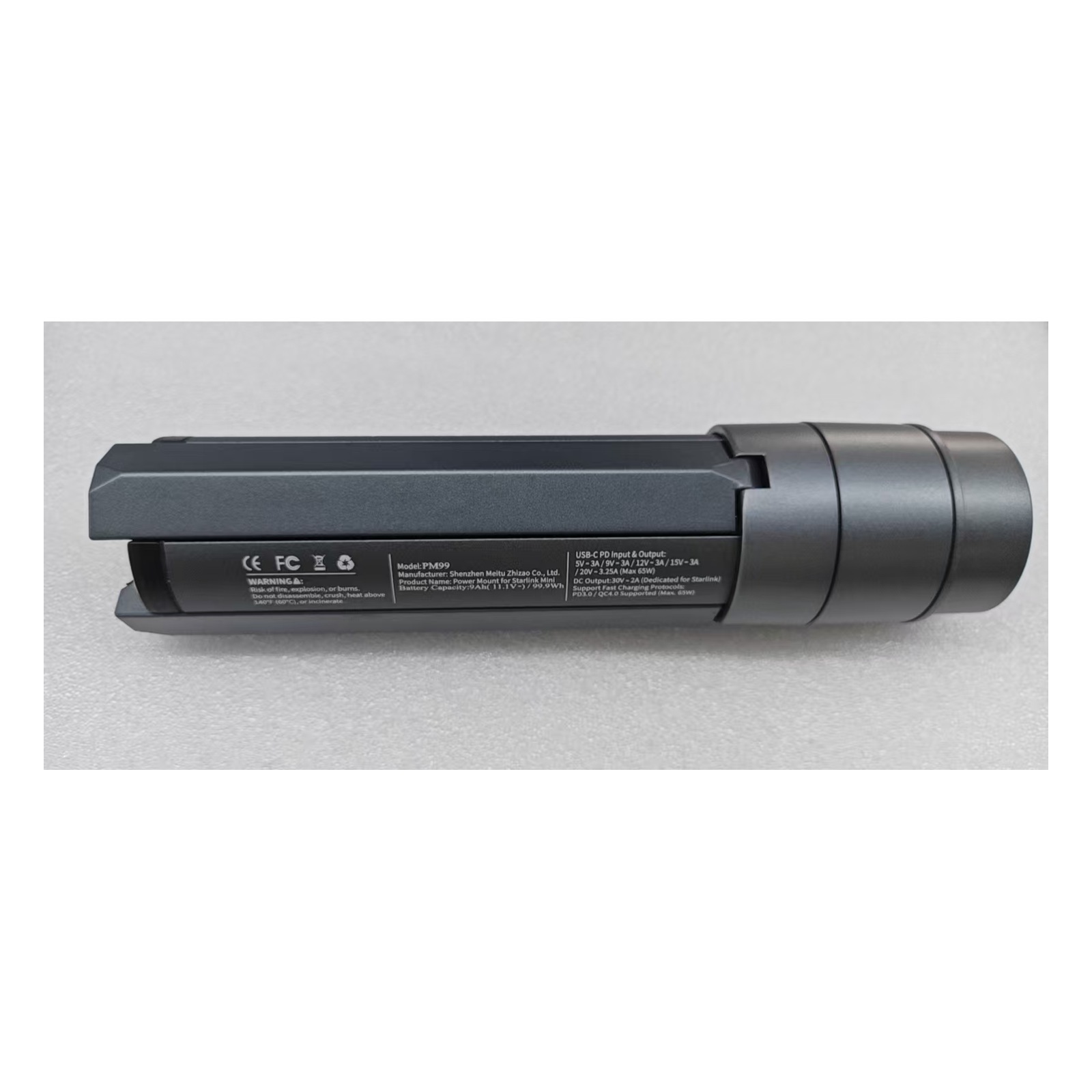
If you do go the DC route, the Fusynthx PM99 power mount exists for exactly this: 99.9 Wh, a 30 V DC output aimed at the Starlink Mini, and a USB-C PD input for recharging from a car or a solar panel. It is made by Fusynthx, which is our own brand, and is compatible with Starlink rather than endorsed by them. We do not sell it on this site; the reason it comes up here is that it removes one of the two conversions, which is the whole subject of this article.
Two things to check before you buy
Continuous, not peak. Power stations advertise both. A Starlink Mini is a steady low load, so even a small station copes — but the start-up surge and snow melt are what trip marginal units, and they happen at the worst time.
Charging speed. A 500 Wh station that recharges at 60 W over USB-C takes eight hours from flat, which is fine for daily driving and slow for a cabin. A 200 W solar panel with four good hours puts about 800 Wh back in a day, which covers a 500 Wh station with margin.
Do this today: time how long the Starlink Mini actually runs on whatever you have now, then divide your battery’s watt-hours by that number of hours. That gives you the real draw including losses — and it is the only figure worth putting into any sizing calculator.
This is part of the Starlink 101 framework, in the power and install chapter. For the general arithmetic behind DC battery sizing, sizing a battery for a Starlink dish works from usable watt-hours rather than AC ratings, and how much power a dish draws covers the standard kit if you are comparing the two.