Two questions decide whether your dish works while moving, and people almost always ask only one of them. The first is whether the hardware is permitted in motion. The second is whether the plan allows it. A kit can pass the first and fail the second, which is the expensive way to learn that a residential subscription does not travel.
There are three situations, not two: stationary, roaming between cells, and offshore. They need different answers, and the middle one is where most of the confusion lives.
Stationary is the default, and it is stricter than it sounds
Residential service is provisioned to an address and a cell. That is not a technicality — it is how capacity is planned. Using a residential kit while driving is not merely unsupported; on residential terms in-motion use is not permitted at all.
People get away with it for a weekend because the system does not immediately stop working. “It worked” is not the same as “it is allowed”, and the difference shows up when a cell is congested or when service is reviewed.
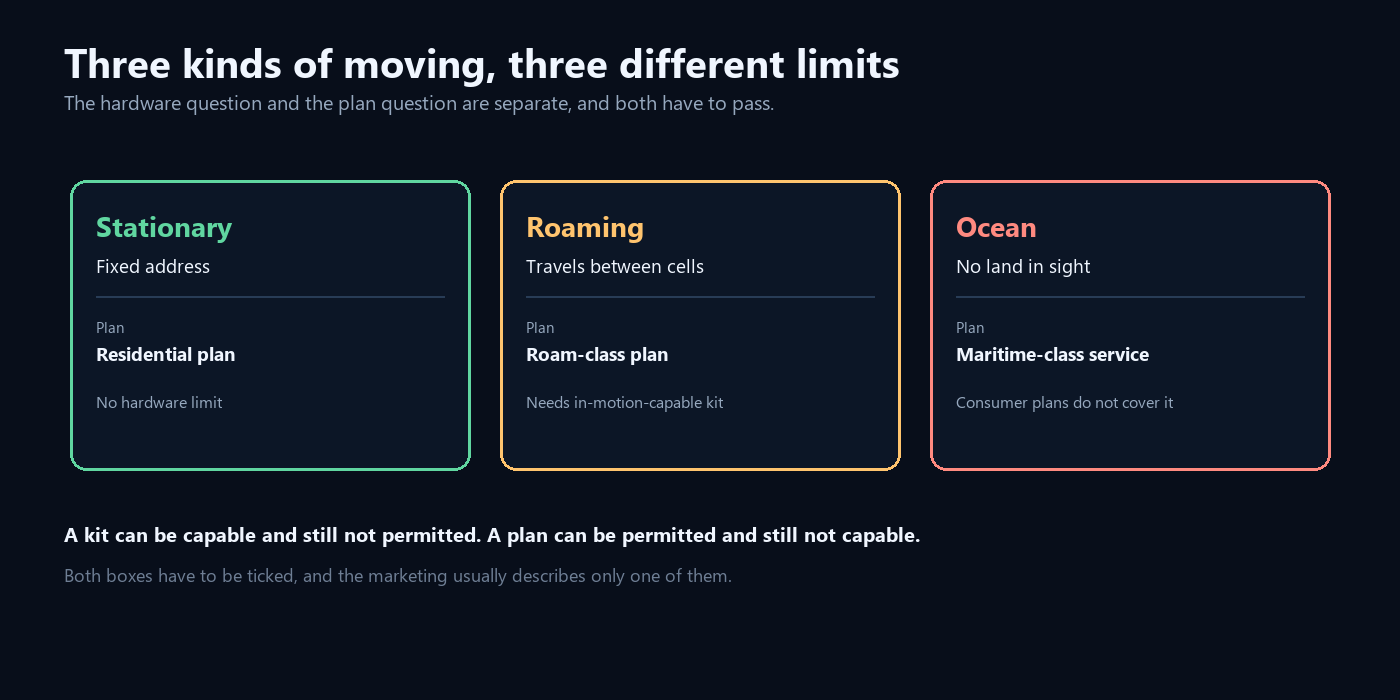
Roaming is a plan, not a setting
Roam-class service exists to let a kit move between cells. It costs more per unit of capacity because it consumes capacity in places you did not buy it, and it can be deprioritised behind residential traffic in a busy cell.
Three practical consequences people discover late. The price is not the residential price. Availability during peak is worse, not better. And the plan has terms about where it can be used — roaming is not a global licence, and the limits are written down even when they are not advertised.
| Situation | Hardware must be | Plan must be | Typical failure |
|---|---|---|---|
| Fixed home | Any current kit | Residential | None, if address matches |
| Travel between cells | In-motion capable | Roam-class | Residential plan used on the road |
| Offshore | Marine-oriented | Maritime-class | Consumer plan expected to work at sea |
The ocean is a different product
Consumer plans are built around land: ground stations, cells, and a market of houses. Once you are far enough offshore that no ground station serves you, the service you need is not a bigger roaming allowance — it is a different service class sold for vessels.
That is why coastal use and ocean crossings behave differently with the same hardware. A few miles out you are still in a cell. A few hundred miles out you are in a market segment with its own terms, its own price, and its own hardware requirements.
Satellites cover the planet; ground stations and cells do not. The service you buy is tied to infrastructure on land, and offshore coverage is a separate product rather than a bonus.
Hardware capability is one of the two conditions. If the plan is residential, in-motion use is not permitted regardless of what the dish can do.
For a van or a caravan, the plan is usually the binding constraint and the dish is already capable. For an ocean passage it is the reverse: neither is capable without the marine product.
Why a moving dish is harder than a fixed one
A stationary dish has one job: hold a link to whatever satellite is overhead. A moving dish has the same job while the geometry changes, which means more frequent handoffs, more time spent acquiring, and a smaller margin for obstructions.
That is the technical reason in-motion hardware is certified separately. The dish has to track through motion, and the mount has to hold it steady enough that tracking remains possible. A good mount on a bad surface is still a moving dish.
It is also why performance in motion is worse than the same kit stationary, even when everything is permitted. The link is doing more work, so the delivered speed is lower — and that is a design consequence rather than a fault.
The transition is where plans bite
Most people who get this wrong do not get it wrong offshore. They get it wrong in the driveway: they buy a residential kit for a house, then take it on a trip, and discover the plan is the part that does not travel.
The fix is a plan change rather than a hardware change, and it is worth doing before the trip rather than during it. Pausing one plan and starting another is a support interaction, and support is exactly what you do not want to be arranging from a campsite with no signal.
What to check before you move the dish
- Name the situation. Fixed, roaming, or offshore. Everything else follows from which of the three you are in.
- Check the hardware list, not the marketing. Starlink publishes which kits are supported in motion; a new generation can be excluded explicitly even if it is technically capable.
- Read the plan terms for the word “permitted”. Not “supported”, not “works with” — permitted. It is a different word with a different consequence.
- Ask what happens offshore. If the answer is vague, you are looking at the wrong product class, and no amount of power or mounting advice fixes it.
One more distinction worth holding onto: roaming is about where you are, in-motion is about whether the dish is moving. A dish parked at a campsite two states from home is roaming. The same dish on the roof of a moving vehicle is in motion. Those are two separate permissions, and a plan can grant one without the other.
Do this today: find your plan’s terms and search the document for “in-motion” or “mobile use”. If the phrase is absent, assume it is not permitted until someone shows you where it is. That one search prevents the most common and most expensive mistake in this chapter.
This is part of the service chapter in the Starlink 101 framework. How cells work explains why a moving dish is a different problem from a fixed one, and the RV mounting guide covers the hardware half of the same question.