Two houses eight hundred metres apart can get different speeds from the same provider on the same plan, at the same moment, looking at the same satellites. The variable is not the dish and it is not the subscription — it is which cell each dish sits in, and how full that circle happens to be.
Understanding cells explains most of the things people find mysterious about satellite internet: why a review from one town does not describe another, why speeds changed when a subdivision was built, and why “up to” is doing so much work in the marketing.
A cell is a circle of shared capacity
The service area is divided into cells, roughly fifteen to twenty-five kilometres across. Every dish inside one cell draws from the same pool of radio capacity, delivered by whichever satellite happens to be overhead at that moment.
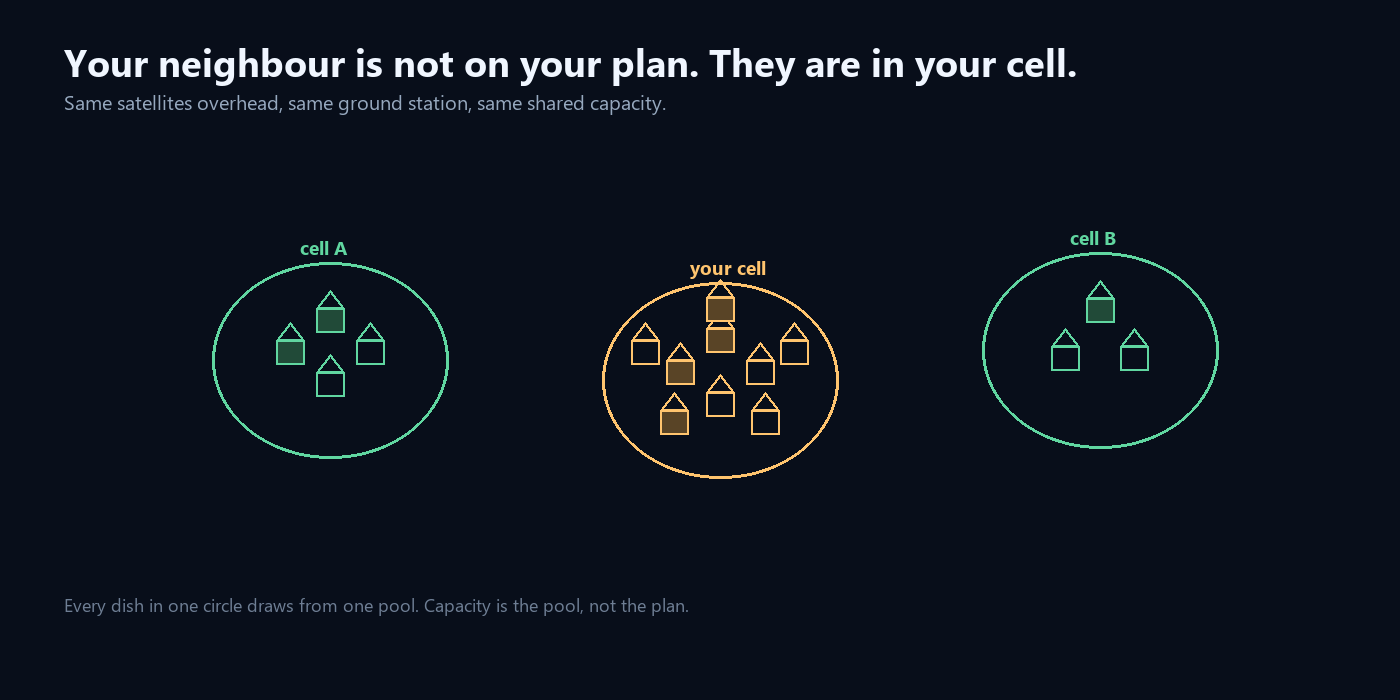
The important consequence is that capacity is a pool, not a pipe. Adding a customer does not take a dedicated lane away from you; it adds a share of demand to a fixed supply. That is why the effect is invisible at low load and very visible at high load, and why it appears as slowdowns rather than outages.
Why the neighbour’s number differs
Cells have boundaries, and a boundary runs between houses. Two dishes close together can be served by different pools with different load, which is the single most common reason two neighbours report different speeds.
A clean obstruction figure and a good cable run matter, but they set a ceiling rather than a daily number. If both installs are clean, the difference you are seeing is load, not hardware.
Deprioritisation exists on lower tiers and during congestion. Two dishes on different plan tiers in the same cell will behave differently at peak, and that is by design rather than a fault.
Cells are kilometres wide. A metre or ten will not move you across a boundary — but it can change which satellites serve you within the same cell, which is a different and much smaller effect.
Why pricing is per address, not per country
Because capacity is local, price and availability are local too. A cell with spare capacity gets promotions and instant shipping; a cell at its limit gets a waitlist and full price. Same country, same satellites, different offer.
That is also why “is Starlink available here” is a weaker question than it looks. The honest version is “is there capacity in the cell that covers my address, and what does that cell’s plan cost”. The coverage map answers the first; only the address lookup answers the second.
The gateway is a second shared pool
Cells do not exist in isolation. Traffic from your cell goes up to a satellite and down to a ground station, and that gateway is shared too. A cell with spare radio capacity can still feel slow if the gateway behind it is busy, which is why the evening slowdown sometimes appears on days when the sky looks quiet.
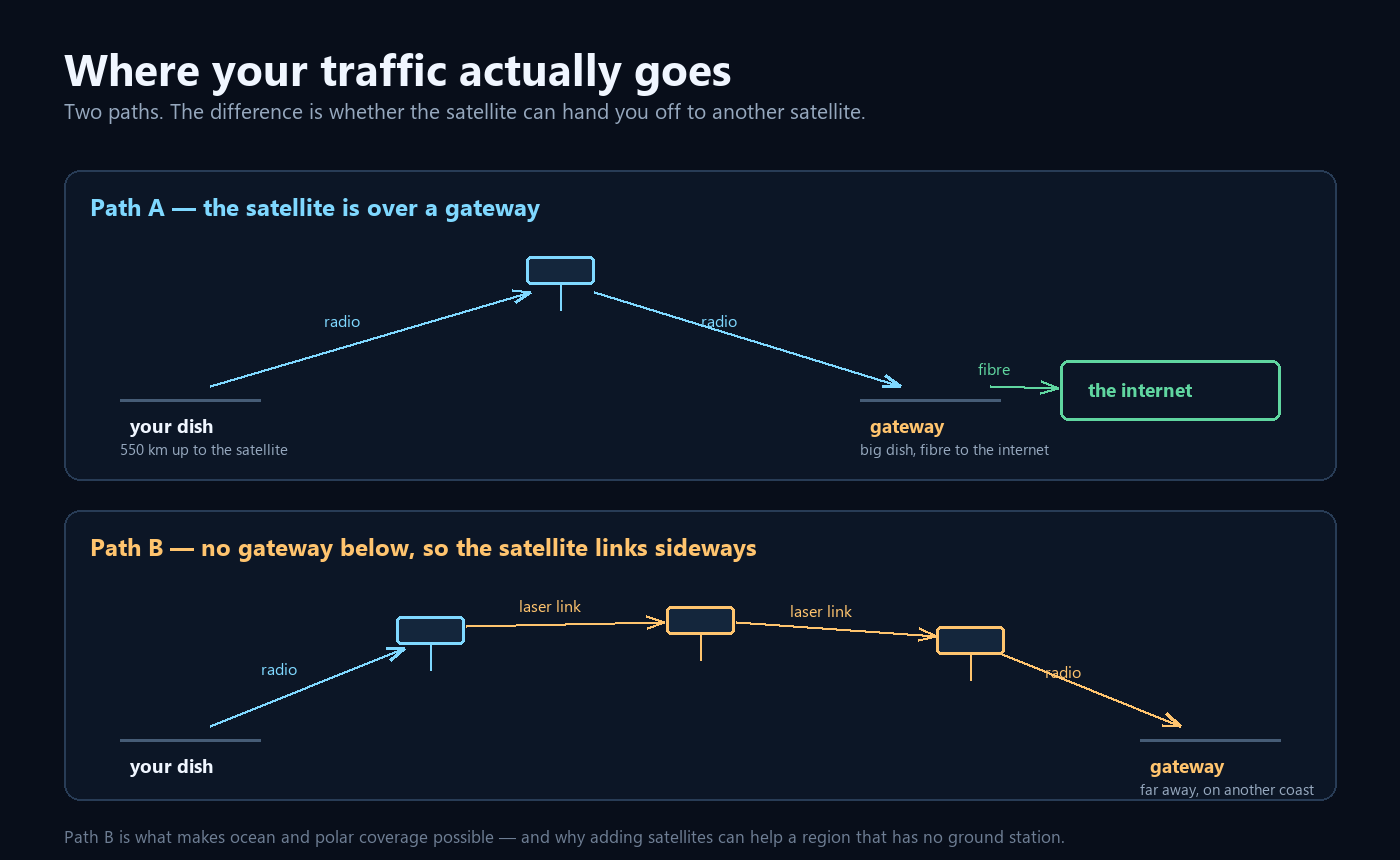
In practice this matters for diagnosis. If your speed is poor and the obstruction figure is clean, the constraint is somewhere upstream of your dish — in the cell or at the gateway — and nothing on your roof will change it.
Capacity is not the same as coverage
These two get conflated constantly. Coverage asks whether a satellite can see your dish. Capacity asks how much data the system can move for the dishes in your cell at once.
A cell can be fully covered and short of capacity — that is the waitlist case. It can also be covered, provisioned and still slow for an hour a night, which is the congestion case. Neither is a coverage failure, and that is why “the map says I am covered” is not an argument when speeds fall.
What changes a cell’s load overnight
- New housing. A subdivision that did not exist last year adds dishes to a pool that was sized before it.
- Seasonal population. Holiday areas are quiet in March and saturated in August.
- Migration events. When something forces people to relocate into one area, they all arrive in the same cells at once. Evacuation zones and disaster response areas are the extreme version.
- Everyone at once, every evening. The ordinary case, and the one that sets expectations.
None of these are faults. They are the predictable consequence of selling a shared resource into a market where demand is unevenly distributed, and they are why a provider prices and provisions by cell rather than by country.
What you can and cannot do about it
| Action | Helps? | Why |
|---|---|---|
| Better mount, clear sky | Yes, up to a ceiling | Removes your own losses |
| Newer dish, same cell | Marginally | The pool is unchanged |
| Higher plan tier | Yes at peak | Priority within the same pool |
| Moving house | Only if the cell changes | Kilometres, not metres |
| Complaining about evening speed | No | It is capacity, not a fault |
One more practical detail: the cell boundary is not published, so you cannot look yours up. What you can observe is behaviour. If the same plan behaves well at one address and badly at another a few kilometres away, you have found the boundary empirically — and that is more useful than any map.
Do this today: run the same speed test at 7am and at 9pm. A large gap means you are cell-limited and there is nothing to repair. A small gap with poor numbers all day means the constraint is your install or your hardware — and that is worth investigating.
This is the first entry in the service chapter of the Starlink 101 framework. If your slowdowns cluster in the evening, drops that only happen in the evening separates congestion from a fault, and why a speed test can be fine while everything feels slow covers what the test does not measure.