Starlink’s US plans are not one ladder with four rungs. They are several separate products — a residential line, a roaming line, and a business line — and the names change more often than the prices do. What matters for a buying decision is three things: whether the plan is tied to an address, what happens when the cell is busy, and whether you can pause it.
Everything below reflects published US pricing as of late 2026. Treat the structure as stable and the numbers as perishable.
The three things that actually differ
Marketing copy lists speed tiers. The differences that change your life are structural.
Residential service is provisioned to a specific address and a specific cell. Roaming and mobile plans are not, which is why they cost more per unit of capacity and can be deprioritised sooner. If you move the dish, this is the question that decides whether the plan follows you.
Tiers increasingly differ in priority during congestion rather than in headline speed. Two dishes can report the same download figure at 3am and behave completely differently at 9pm. That night-time difference is what you are actually paying for.
Pausing exists on some service lines and not others, and the terms change. If your use is seasonal — a cabin, a boat, a second home — this single feature is worth more than a speed tier, and it is the one people forget to check before ordering.
Why the cell matters more than the tier
A plan is a claim on a shared pool. The pool is the cell, and cells differ in how full they are — which is why the same plan can feel like fibre in one county and like 2010 in another.
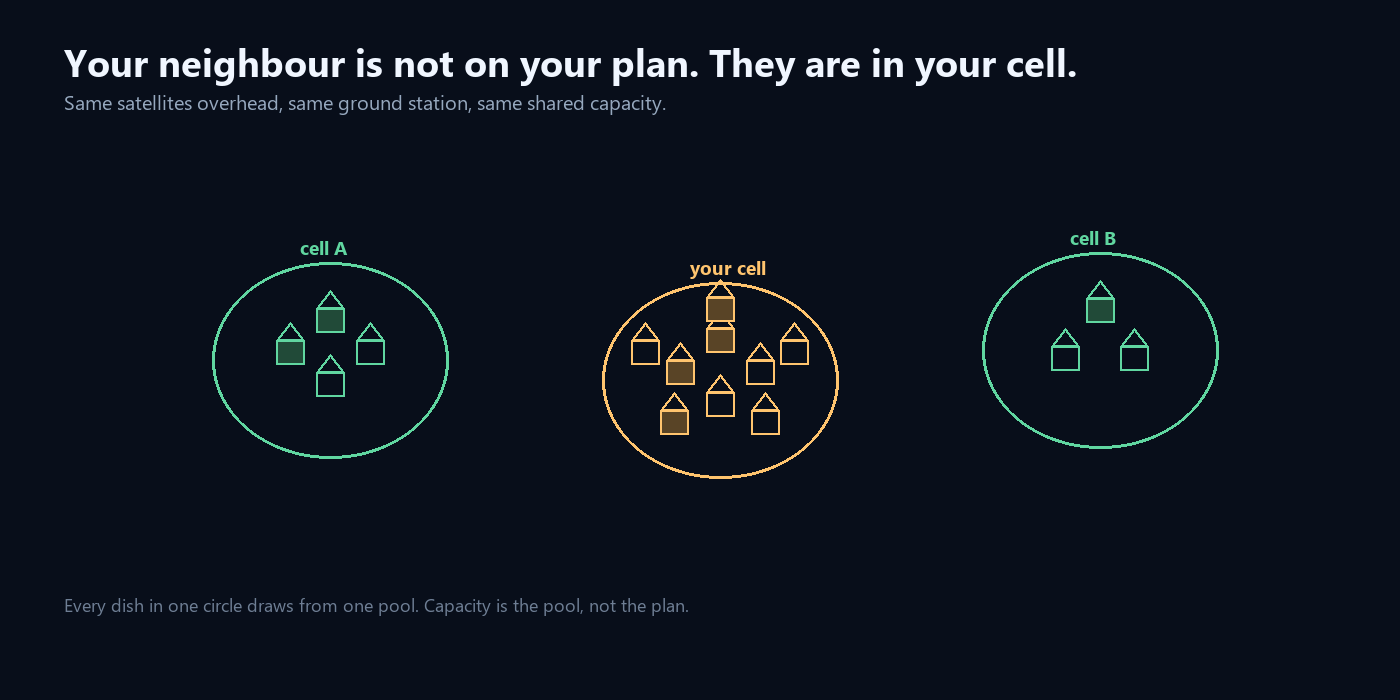
This is also why availability and price are quoted per address. A cell with spare capacity gets instant shipping and sometimes a promotion; a cell at its limit gets a waitlist. The map tells you coverage; the address lookup tells you terms.
A rough map of the tiers
| Service line | Tied to address | Best for | Watch out for |
|---|---|---|---|
| Residential, standard | Yes | A fixed home with no fixed line | Cannot be taken on the road |
| Residential, higher tier | Yes | Priority at peak, more throughput | Cost per Mbps is worse |
| Roaming / mobile | No | RV, boat, travel | Deprioritised before residential |
| Business | Usually yes | Static IP, SLA-ish terms | Overkill for a household |
Deprioritisation, in plain terms
When a cell is oversubscribed, the operator chooses whose packets go first. Residential traffic is ahead of roaming traffic; the higher residential tier is ahead of the standard one. Nobody is throttled to a fixed speed — your share simply shrinks as the queue grows.
That is why the honest way to read a tier is “priority at peak”, not “faster”. At 3am every tier on the same cell behaves identically, because there is no queue to prioritise within.
Data allowances and the fair-use line
Nominal “unlimited” plans still carry fair-use language. In practice this rarely bites a household that streams, and regularly bites people running a business out of a house — backups, uploads, camera streams. If your monthly upload is measured in terabytes rather than gigabytes, read the fair-use section before choosing a residential tier.
The pattern to watch for is not a hard cap but a change in priority once you cross a threshold. That shows up as slower evenings after a heavy month, which is easy to blame on the network and easy to avoid by choosing the right line in the first place.
What the hardware terms do to the maths
The monthly figure is only part of the cost. US residential service has been sold both as an outright purchase and as a rental arrangement depending on the generation and promotion, and the two produce very different three-year totals.
Before comparing a tier against a fibre offer, get the hardware terms in writing: purchase price or monthly rental, whether it is returnable, and what happens to the equipment if you cancel inside the first year. Those answers move the total by hundreds of dollars in either direction, which is more than any difference between two plan tiers.
The upgrade that is usually wrong
Moving up a tier is the reflex response to slow evenings, and it often does not help. If your cell is saturated, priority buys you a better share of a full pipe — real, but small. If your problem is obstructions or a bad cable, no tier touches it.
The order worth checking is boring: obstruction figure, cable condition, router placement, and what is uploading in the background. Only after those are clean does the tier become the candidate.
What to do before you order
- Look up your own address, not the country page. The number that matters is the one attached to your civic address, including any waitlist.
- Decide whether the dish will move. If it will, you need a mobile-capable line from day one, and the residential price is not available to you.
- Check the pause terms if your use is seasonal. It is buried, and it is the difference between paying for eleven months and paying for four.
- Write down what you will do at peak before you buy. If the answer is “upgrade”, you are buying a plan for congestion rather than a plan for coverage.
One last reframe that saves money: a plan is a claim on a cell, not a speed rating. Two households on the same tier in different cells are buying different products at the same price, and there is no way to know which one you are buying until the dish is on the roof.
Do this today: put your address into the availability checker and note two numbers — the monthly price and the word “waitlist” or “available”. Those two decide more than any review, including this one.
This is part of the service chapter in the Starlink 101 framework. For the cost side in detail, what Starlink actually costs in the US runs the three-year arithmetic, and how cells work explains why the same plan behaves differently two towns over.