Altitude is the only real design decision in satellite internet. Everything else — the dish, the radios, the modulation — is engineering on top of it. Put your satellites low and you get latency close to cable, but each one only sees a small patch of ground for a few minutes. Put them high and one satellite covers a third of the planet for fifteen years, but every packet pays a 35,786 km toll.
That trade is why Starlink needs thousands of satellites while a geostationary operator needs three.
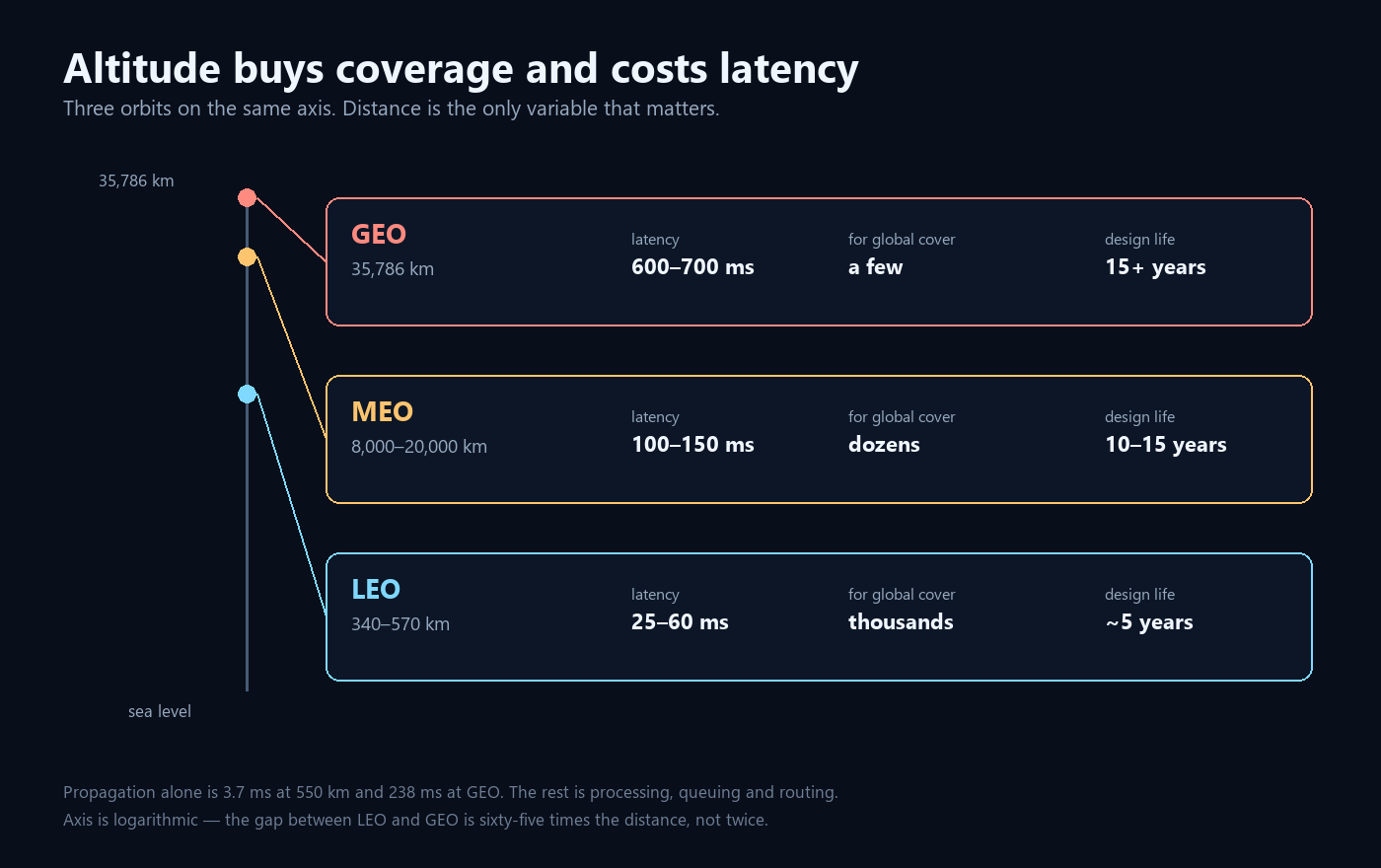
The three shells, and what each one costs
| LEO | MEO | GEO | |
|---|---|---|---|
| Altitude | 340–570 km | 8,000–20,000 km | 35,786 km |
| Round-trip latency | 25–60 ms | 100–150 ms | 600–700 ms |
| Satellites for global cover | Thousands | Dozens | A few |
| Design life | ~5 years | 10–15 years | 15+ years |
| Footprint per satellite | Regional | Large | ~A third of Earth |
Short enough to feel like cable for most use. The cost is numbers: you need thousands of satellites, each lasting about five years because atmospheric drag pulls it down, and each only in view for a few minutes, which is why handoffs happen constantly.
A few dozen satellites can cover the planet with latency around 100 to 150 ms. Good enough for most business traffic, useless for competitive gaming. It exists commercially, mostly in the enterprise and maritime market, but it gets little attention because it is neither the fastest nor the cheapest.
MEO is not theoretical. Operators have run commercial fleets at roughly 8,000 km for years, aimed at ships, aircraft and remote sites that need better latency than geostationary can offer but do not need thousands of satellites. The economics work because the ground terminals are expensive and the customers are institutions, not households.
Three satellites, fifteen years of service, no constellation to maintain. For broadcast, weather imaging and one-to-many distribution it is still the efficient answer. What it cannot do is interactive traffic, because 238 ms of pure propagation is a floor no amount of engineering removes.
The gap between 238 ms of physics and the 600 to 700 ms people actually measure is the interesting part. It comes from processing, older modulation, and in some networks a double hop: up to the satellite, down to a gateway, back up, and down again to reach a different coverage area. That is an engineering choice rather than a law, and newer geostationary fleets do better. They just cannot do well.
Why low orbit needs so many satellites
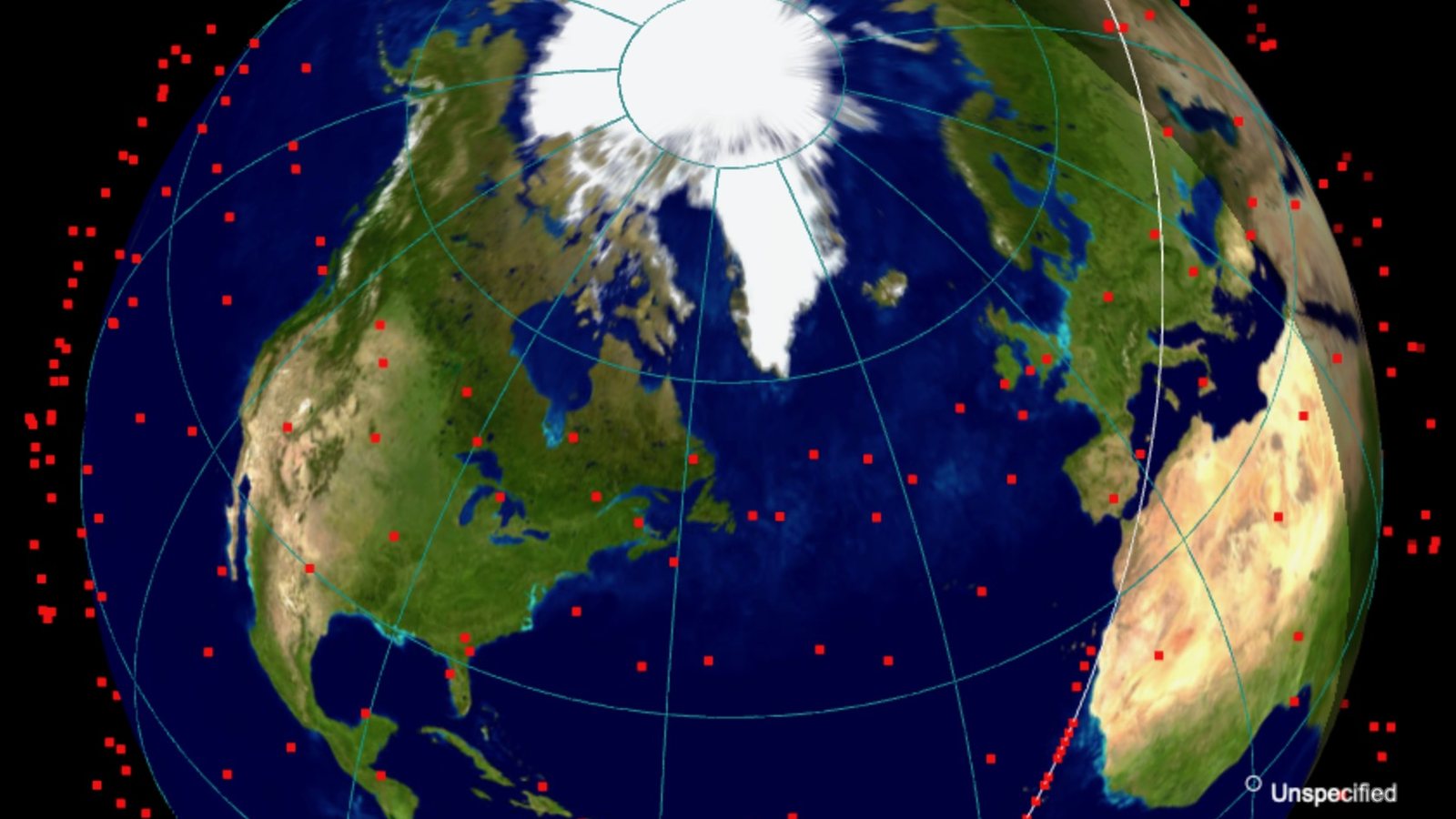
A satellite at 550 km sees a circle a few hundred kilometres across. As it orbits at roughly 27,000 km/h, that circle sweeps across the ground and is gone in minutes. To keep one user connected you need the next satellite already overhead before the current one sets.
Scale that to a planet and the arithmetic is unforgiving. A geostationary satellite covers about a third of the Earth from a fixed point in the sky, so three of them do the whole job. A low-orbit satellite covers a small patch that moves, so you need density at every latitude you serve — and more density where more people live.
Drag is the second cost. At 550 km there is still enough atmosphere to slow a satellite, so it has to spend fuel to hold altitude, and when the fuel runs out it deorbits — which is the good outcome for debris, and the reason the design life is around five years rather than fifteen.
Which raises the obvious question: why not put everything in low orbit? Because the constellation becomes the product. Thousands of satellites means thousands of launches, a continuous replacement pipeline, spectrum coordination across every country you serve, and an orbital debris footprint you have to manage actively. GEO operators avoid all of that by buying three satellites and a launch. They accept the latency as the price of not running a supply chain in space.
There is also a physics reason the middle shell is thin. The Van Allen belts sit between roughly 1,000 and 6,000 km, and again beyond 15,000 km. A satellite parked inside them needs heavier shielding and a shorter service life, which is exactly why MEO fleets cluster above the inner belt and below the outer one.
What this means for the dish on your roof
Two practical consequences follow from the orbit, and both are visible in your own app.
Latency will never drop much below 20 ms. The physics floor is a couple of milliseconds; the rest is processing, routing and the distance to a ground station. No firmware update removes it, and no competitor using the same orbit will beat it by a meaningful margin. Anyone promising single-digit latency over LEO is either measuring locally or guessing.
Your connection is a handoff chain. Every few minutes the dish moves to a different satellite. That is invisible when the sky view is clean and painfully visible when a tree intrudes on the new position, because the dropouts cluster at the moment of switching rather than happening evenly. If your outages come in regular bursts, timing them against the handoff cycle is more useful than re-aiming the dish.
The one number to remember
Sixty-five. That is how many times further a geostationary satellite is than a Starlink one, and it is the entire explanation for why one service feels like cable and the other feels like a phone call to another continent. Everything else in this comparison follows from that single ratio.
Do this today: open the Starlink app and look at the statistics screen during a normal evening. The latency you see there — usually somewhere between 25 and 60 ms — is not a marketing number, it is the orbit made visible. Watch it for ten minutes and you will see it move.
This is the second piece of the Starlink 101 framework. If you want the step before it, how the dish actually talks to a satellite covers the beam and the handoff from the terminal’s side.