The dish survives a Canadian winter better than the equipment around it. Its published operating range goes down to −30 °C and it clears up to 25 mm of snow an hour, so the hardware is rarely the thing that fails. What fails is the battery that cannot accept a charge, the roof that cannot be reached in February, and a plan built for a mild September.
Three separate problems get called “the cold”, and they need three different responses.
What the cold actually does to a dish
Less than people assume. Operating temperature is specified down to −30 °C, and the terminal heats its own face to clear snow. The two real effects are on power and on the mount, not on the radio.
Power first. The heater is what makes a winter day cost more than a summer one, and it is also what stops the dish from being buried — the two are the same mechanism. A dish that appears to be “using more power all of a sudden” in January is working correctly.
Then the mount. Ice adds weight to the arm and wind pushes against it. Starlink’s own installation documentation says mounts are not designed for high-wind, hurricane or tornado loads and that tethering should be used to prevent failure in an unexpected event — which in Canada is not an unusual event.
The problem is usually the battery, not the dish
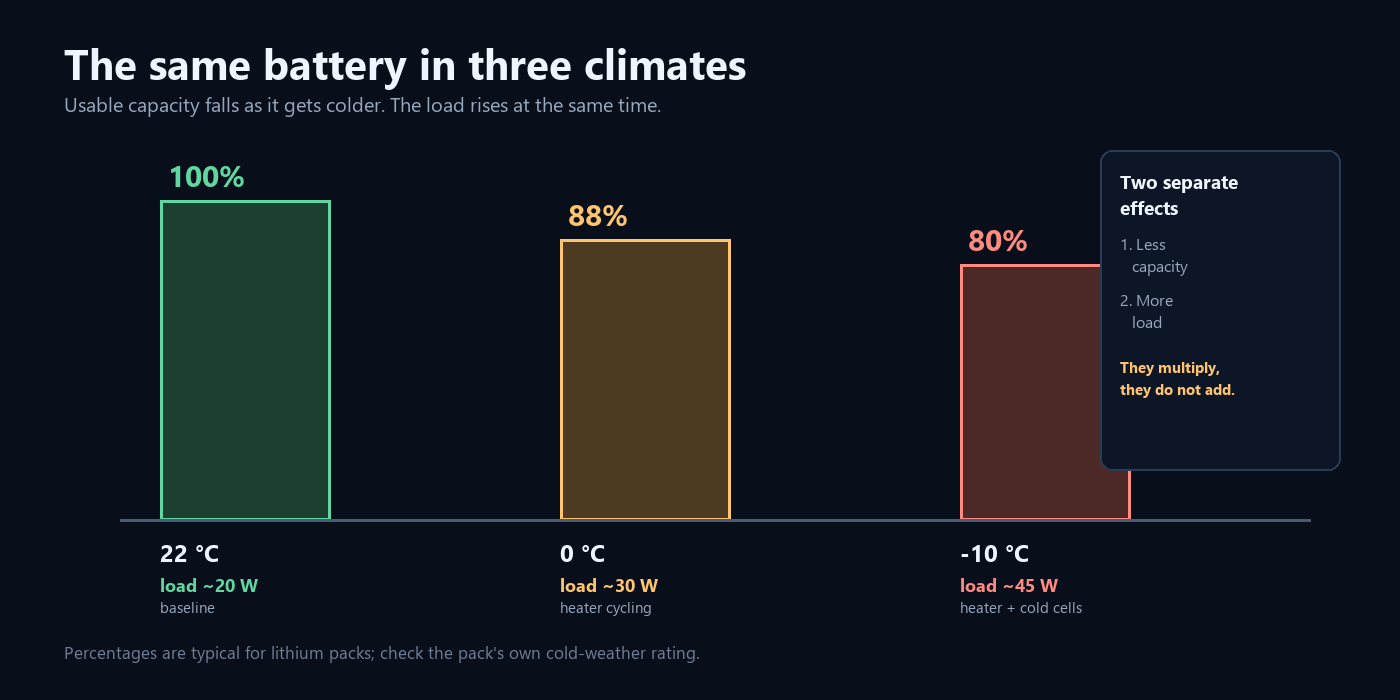
A lithium pack loses usable capacity in the cold — roughly 80 percent at −10 °C, less further down — and most packs refuse to accept charge below 0 °C to protect the cells. Both effects show up in a Canadian winter, and they compound.
The practical consequence: a system that runs fine on a battery in October can fail in January without anything being broken. The pack is simply colder, and the load is higher at the same time.
| Condition | Capacity | Dish load | Runtime from 1 kWh |
|---|---|---|---|
| 20 °C, dry | ~100% | ~25 W | ~34 h |
| 0 °C, snow cycling | ~88% | ~32 W | ~27 h |
| −20 °C, melt active | ~75% | ~40 W | ~19 h |
The published operating range goes to −30 °C. Below that, performance is not specified — but the far more common failure in Canada is the power system, not the terminal.
Snow on the face is cleared by the heater, which is why it is rarely the cause of an outage. A heavy, wet snowfall faster than 25 mm an hour can outrun it, and that is when the dish does lose its view.
Keeping the pack warm removes more of the problem than adding capacity does. An insulated box in a heated space is cheaper than doubling the battery bank.
Three fixes that cost little
- Keep the pack above freezing. Indoors, in a heated compartment, or in an insulated box with a small heat source. Warm cells deliver more and accept charge again sooner.
- Clear snow by hand when it is heavy. The heater can outrun ordinary snowfall; it cannot outrun a wet 40 mm dump. Clearing once is cheaper than running the heater all night.
- Stow before a freeze, not after. Ice forming around the pivot is the most common cause of a dish that will not move, and it is entirely avoidable.
Snow load is a mount question
A dish sheds snow from its face, but the rim and the arm collect it. Add ice and the mass on a small bracket climbs quickly, and the bracket was chosen in July for a dish that weighed 1.1 kg.
This is the argument for a mount with margin rather than one sized exactly: a bracket rated for twice the dish weight costs a few dollars more and does not care about February. It is also the reason the manufacturer’s tethering advice is worth following literally rather than treating as boilerplate.
What differs between a Quebec winter and a prairie one
Humidity and wind, mostly. A wet, heavy snowfall in the east outruns the heater sooner than the dry, blowing snow of the prairies, which tends to clear itself and drift elsewhere. Wind matters more where there is nothing to break it, and that is a mount and tethering question rather than a dish question.
For anyone choosing equipment, the useful distinction is not province but exposure: a dish on an exposed roof in either region faces the same wind load, and both benefit from the same margin.
The Canadian-specific part: access
In most of Canada the dish is on a roof, and in February that roof is not somewhere you want to be. Every decision that assumes “I will just go up and check” is a decision made in the wrong season.
So favour mounts you can service from the ground or from a ladder placed safely, keep the cable run accessible, and put the reset you will eventually need somewhere reachable in boots. A slightly worse view from a reachable position beats a perfect view that requires a roofing contractor in January.
If the connection drops in a storm
Check the power before the sky. In a Canadian winter storm, a brownout from a loaded battery is far more likely than an obstruction, and it presents identically: the app shows a drop, then recovery, then another drop.
If the obstruction figure has climbed since autumn rather than jumped, suspect ice on the arm or a mount that has shifted. If it is unchanged and the drops are short and repeated, look at the supply.
One habit worth adopting before the first freeze: photograph the dish and the mount from the same spot, then repeat it in March. Aim drift and fastener movement are invisible week to week and obvious across a winter, and the photo is the only record you will have.
Do this today: find your battery’s charge cutoff temperature in its manual. If it is 0 °C, decide now where the pack sleeps in January — that single decision prevents the failure mode most Canadian off-grid setups hit in their first winter.
This is the first entry in the Canada series, part of the Starlink 101 framework. For Canadian pricing and availability, what Starlink costs in Canada covers the tiers, and the cold-weather power guide has the full arithmetic.