Running Starlink from a 12 V system works, but not because 12 V is a good voltage for it. It works because converters have become cheap and efficient enough to hide the fact that you are moving the same power at a quarter of the pressure — which means four times the current, four times the voltage drop, and four times the sensitivity to every connection in the chain.
That is the whole story. Everything below is which converter to use, which gauge to run, and the three failures that account for most of the “my Starlink keeps rebooting in the van” posts.
Why 12 V is harder than the number suggests
Power is voltage times current. Move 40 W at 48 V and you need 0.83 A. Move the same 40 W at 12 V and you need 3.3 A. The wire does not care about your intentions — it dissipates power in proportion to the square of the current, so the same cable loses about sixteen times as much energy at 12 V as it would at 48 V.
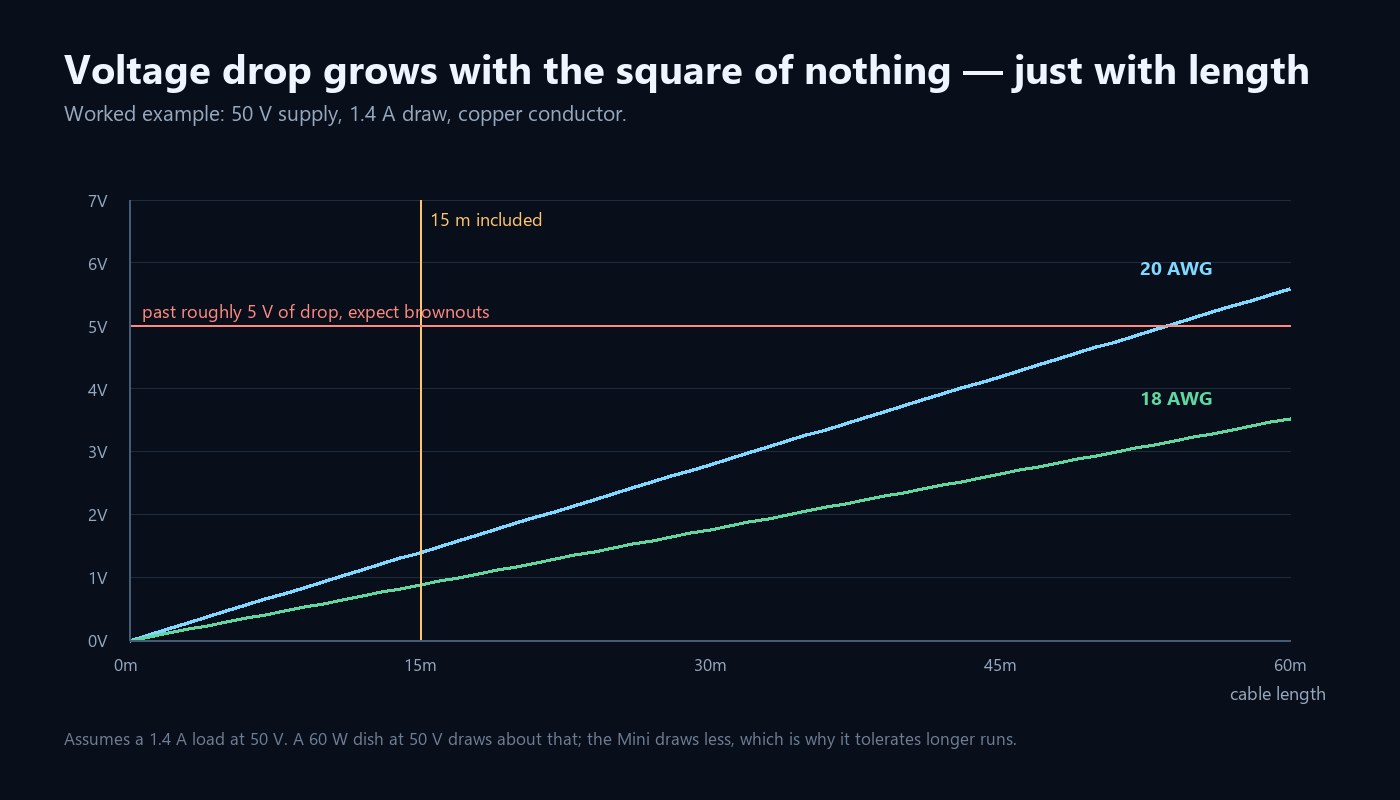
In practice that means two things. The cable has to be thicker than you would guess, and the voltage at the far end sags more, which matters because a DC appliance does not tolerate a sag the way a mains appliance does. A dish that sees 11.2 V instead of 12.4 V may boot, draw more current to compensate, sag further, and reset. That loop is what a “random reboot” usually is.
Three setups, three verdicts
Short runs, a battery with real capacity behind it, and a converter sized for 60 W. This is the case 12 V was already built for, and it is where people report the fewest problems — provided the run is under a few metres and the converter is not a 20-dollar part rated “up to 120 W” in a listing photo.
The same system, with one difference that bites: runs are longer, connections are more numerous, and salt finds every one of them. On a boat the failure is rarely the converter, it is a corroded terminal adding resistance you cannot see until the dish resets under load.
The Standard kit wants a mains supply or a proper 48 V PoE arrangement, and pulling 60 to 90 W through a 12 V boost converter makes the losses real. If the cabin has an inverter already, using it is often the simpler answer, even though it looks less elegant.
The converter question
You have three ways to turn 12 V into something the dish accepts, and they are not equivalent.
| Approach | Efficiency | Use when |
|---|---|---|
| DC-DC boost converter | 90–95% | Default for van and boat installs |
| Inverter to mains, then the original supply | 75–85% total | You already have an inverter and the dish is not the main load |
| Native DC input (Mini only) | Best | The kit accepts DC directly — skip the conversion entirely |
One sizing rule that prevents most of the frustration: buy the converter for continuous current, not the peak printed on the box. A unit advertised as “120 W” often means 120 W for a minute, with 60 W continuous — and a dish draws continuously for hours. Derating to about 70 percent of the headline figure is the difference between a converter that lasts and one that runs hot and shuts down.
Which is why the inverter route deserves a fair hearing rather than dismissal. If a cabin already has one running for a fridge, the marginal cost of plugging in the original supply is a few percent of efficiency, not a new component to buy, wire and fuse. Elegance is worth less than reliability when the alternative is another connector in a damp shed.
The Mini is the happy case, because it takes DC input across a wide range and does not need a converter at all if your bank is in that range. The Standard kit is not: it expects its own supply, and that supply expects mains-style voltage. That single difference decides most of the architecture on a small boat.
Wire gauge, in one table
For a 40 W load at 12 V — about 3.3 A — keep the round-trip drop under half a volt. That gives you these rough limits for copper:
| Gauge | Round trip under 0.5 V | Typical use |
|---|---|---|
| 18 AWG | ~2.5 m | A short lead inside a vehicle |
| 16 AWG | ~4 m | Battery to converter |
| 14 AWG | ~6 m | Across a van |
| 12 AWG | ~10 m | Boat runs, cabin to shed |
If you only remember one line from this article: the fuse goes at the battery, not at the dish. A short in a long run with no protection at the source is how 12 V systems start fires.
Size that fuse to the wire, not to the appliance. A 14 AWG run wants a 15 A fuse because that is roughly what the copper can carry without becoming the fuse itself; a 25 A fuse on the same wire protects the fuse and nothing else. The dish will never draw enough to blow a correctly sized one, which is exactly the point — the fuse is there for the day the insulation chafes through.
The three failures you will actually hit
- Reboots under load, fine at idle. Voltage sag. Shorten the run, go up a gauge, or check the converter’s real current rating rather than its peak.
- Works in summer, fails in winter. Colder batteries sag more and the heater draws more at the same time. A marginal install fails exactly when you need it.
- Intermittent, no pattern. Almost always a connection: a cigarette plug with weak spring tension, a corroded ring terminal, or a fuse holder with a loose blade. Wiggle test each joint while watching the dish.
A multimeter across the converter’s input while the dish is working tells you more than any spec sheet. If you see below about 11.5 V under load on a 12 V nominal system, the run is too long or too thin, and no amount of extra battery capacity fixes it — the battery is not the problem.
Do the same measurement at the dish end if you can reach it. The difference between the two numbers is the drop your wiring is costing you, and it is usually larger than people expect once a cigarette plug is in the path.
Do this today: put a multimeter on the input of your converter with the dish running, note the number, then do it again with the fridge or another big load on. If the second reading sags meaningfully, your 12 V run is the weak link — fix the wiring before buying another battery.
For the power side in more depth, the wattage breakdown covers what the dish actually draws and why it moves, and the Starlink 101 framework puts 12 V in context: sky view first, then power, then cable.